|
|
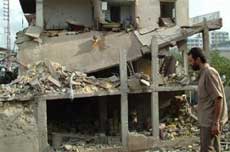
A destroyed building in
Halba town in Akkar in northern Lebanon August 13,
2006 — the original neocon plan has been
reordered, starting with Lebanon (Reuters photo).
|
Using Hizbullah's July 12
capture of two Israeli soldiers — whose unit had
apparently crossed the Israeli border into Lebanon — as
a pretext, the Bush administration quickly sprung into
action — imagining yet a new Middle East, where
democracy and freedom reign over militancy and
oppression.
Since the neoconservative
takeover of America's foreign policy, it has become
apparent that neocons do not actually operate with
impulsiveness. The plan for a new Middle East was
introduced as early as 1992 — in Paul Wolfowitz's
"Defense Planning Guidance" draft, presented to the US
Defense Department. The plan's elements were accentuated
in 1996 by Richard Perle in a report directed at the Israeli
government.
Washington's neocons exploited
the September 11 tragedy to achieve what until then
seemed unfeasible: They planned for an invasion of Iraq,
then Iran and Syria, which would naturally lead to the
plunging of Lebanon into Israel's political sphere.
Meanwhile, Israel would be entrusted with the ominous
task of imposing whatever solution it found suitable on
the Palestinians. But when it all seemed set for the
advent of a new Middle East, Iraqis exhibited stiff
resistance that bogged down America's military power and
stretched its resources beyond expectations. The tens of
billions of initial war costs led to tens of millions
more, with no end in sight.
It was all but a secret that
the neoconservative dream of a new Middle East would
once again be postponed. So the debate was tilted toward
a much more urgent issue: how to escape Iraq with the
least political damage possible. Yet, as some Americans
wrangled with the quandary, desperate elements with and
around the administration insisted that a new Middle
East was still possible.
|
The democracy nuisance created
yet another embarrassing episode for the Bush
administration, the supposed harbinger of
democracy. |
But that hope too seemed to
slowly falter as Iran insisted on its right to civilian
nuclear technology with little or no enthusiasm by
America's top military echelon to respond by exporting
US military blunders east of the Iraq border.
Add to this eerie scenario the
backfiring of their championed Middle East democracy
project, which was was aimed at rearranging the region
using the back door, with democracy being the new
mantra. The advent of Hamas, Israel's most formidable
foe in Palestine — as a result of one of the most
transparent, democratic elections ever held in the
Middle East — exposed the American democracy charade in
the most ironic ways: The same Palestinians who were
told to live up to Israel's high democratic standards
were collectively punished thereafter with the
withholding of aid for doing just what they were
told.
The democracy nuisance created
yet another embarrassing episode for the American
administration, the supposed harbinger of democracy. As
US secretary of state Condoleezza Rice barefacedly
journeyed to world capitals to ensure the success of its
government's sanctions on Palestinians, Israel unleashed
a violent campaign in the Occupied Territories, killing
hundreds and arresting scores of Palestinian MPs and
cabinet ministers.
Now that most of the doors had
been shut before a new Middle East, there remained one
unexplored possibility: the reordering of the original
neoconservative plan, starting with Lebanon. But why
Lebanon?
|
Media reports suggest that
Israeli war plans against Lebanon were concocted
years ago. |
The original neoconservative
doctrines — Paul Wolfowitz's doctrine of 1992, Pearle's
foreign policy document of 1996, and those of the
Project for a New American Century in later years —
assured the collapse of the Lebanese front immediately
after the elimination of the Syrian threat. Syria, it is
believed, holds all the cards to Lebanese politics.
Syria, however, is hardly
perceived as a military threat the same way Iran is;
thus political channels — at the United Nations and US
Congress — were successfully used to pressure Syria to
concede its Lebanese fortress to a pro-American Lebanese
government. The subsequent events were anything but
consistent with Israel's designs: Hizbullah was not
disarmed when its disarmament was required to pave the
way for the triumphant return of Israel to extend its
political outreach as a regional power to its neighbor
to the north, and to further push an increasingly
isolated Syria into a corner, getting it to eventually
deport anti-Israeli occupation factions based in
Damascus.
Since desperate times call for
desperate measures, a war on Lebanon was necessary.
Media reports suggest that Israeli war plans against
Lebanon were concocted years ago. UN reports indicate
that Israeli forces have crossed the border into Lebanon
on numerous occasions in the past since the July 2000
Israeli withdrawal from most Lebanese territories, a
withdrawal that went unchallenged by the Lebanese
resistance. July 12 was the exception. Why Hizbullah
chose to respond to the Israeli provocation at such a
scale on that specific date remains unclear. Did its
leadership believe that capturing Israeli soldiers would
strengthen their position when the predicted Israeli war
was unleashed?
The fact of the matter is that
the war on Lebanon was premeditated in the hope that an
easy war would bring an end to the resistance, coerce
the country into an unwanted peace settlement, deliver a
blow to Iran and Syria's regional ambitions, but most
importantly downgrade Iran's regional import, perhaps as
a stepping stone toward the long-envisioned regime
change.
The defeat of Hizbullah would
have breathed life and enabled the full return of the
original neoconservative plans to the Middle East. It
was no wonder that Secretary Rice took the podium and
giddily declared the need for a new Middle East almost
immediately after Israel began pounding Lebanon's
civilian infrastructure. Such a Middle East would indeed
require time and patience and anything but an "immediate
ceasefire."
The war on Lebanon indeed is
generating a new Middle East, but hardly the one the
United States and Israel have long fought for. Arabs,
for the first time in their recent history, unreservedly
speak of a real military victory, and of course, neither
the United States nor Israel is prepared to accept such
an outcome. Without a doubt, a decisive battle for a new
Middle East is going on in Lebanon. The question is who
will define it and at what cost.

.jpg)








.jpg)




