
|
Published by the GLORIA Center, |
Volume 10, No. 3, Article 9/10 - September
2006 |
|
|
This article examines the economic, social, and political impact of four years of intensive terrorism on Israeli society. The article surveys economic data on GDP, employment rates, foreign direct investment, stock market performance, as well as other parameters. It also analyzes available data on public opinion, voting behavior, and psychological well-being. After surveying and analyzing the data, the author concludes that the impact of terrorism on Israel during the period in question was far less significant than conventional wisdom might suggest. The phenomenon of Terrorism is one that the United States and Europe are likely to be forced to confront with increasing frequency. While there have not been any significant attacks in the United States since September 11, 2001, the lull in attacks cannot be expected to last forever. Europe, on the other hand, has had to cope with more recent attacks, such as the Madrid train bombing of March 2004 and the London bombings of July 2005, as well as the knowledge that terrorist cells in Paris, London, Rotterdam, and elsewhere were plotting conventional or WMD attacks. As the particularly virulent brand of Islamic extremism that spawned Al-Qa'ida and similar groups is showing no signs of weakening, the West is likely to continue to experience terrorism (perhaps of variable intensity, but likely to increase as a whole) over the foreseeable future. This then begs the question as to what impact an increase in terrorist activity in Europe and/or the United States will have on Western societies. If one can posit, as a working assumption, that terrorism against Western countries is likely to increase over the foreseeable future, it then becomes necessary to try to understand to what degree terrorism can be expected to impact those societies and their respective economies. This is important, because the nature of the terrorist threat is such that it is difficult to measure the degree of success--or lack thereof--in coping with its effects. Unlike conventional warfare, which allows one to measure success in a relatively straightforward manner in terms of the ability to inhibit and eventually end the enemy's capacity to wage armed conflict, terrorism represents a far more amorphous and ambiguous phenomenon. Terrorism undoubtedly belongs to a far feebler class of violent acts than war, both in terms of the number of casualties that it produces and in terms of the social and economic impact that it has. A single illustration should suffice in this case. For the United States, the Second World War (the largest war of the twentieth century) resulted in 1.08 million casualties (of which 407,316 were deaths). The attacks on the World Trade Center and Pentagon (the single worst terrorist attack in modern history), by contrast, resulted in the deaths of 3,031 persons. In economic terms, the Second World War cost the United States some $15,655 billion (in 1990 dollars). By contrast, the economic cost of the 9/11 attacks has been estimated at $27.2 billion in direct costs and with indirect costs (such as loss of national income, increase in insurance costs, increase in defense spending, etc.) estimated as high as $500 billion.[1] These figures do not take into account offsets to the costs (such as the generation of employment, taxes and general economic activity in the defense sector, the rise in household consumption, and a host of other factors), and consequently the real costs to the U.S. economy are likely to be considerably lower in both cases. Nevertheless, these figures do give some limited sense of proportion. From a societal perspective, the tremendous demographic and social change produced by the Second World War (eight million people moved to the west coast of the United States--the largest western migration in American history--the large scale entrance of women to the workforce, the birth of 76 million "baby boomers," etc.) cannot be compared in any way to the generally minimal societal impact of 9/11. Ultimately then, it is clear that the impact of terrorism is far less significant than war. However, it is equally clear that terrorism does have some economic and social significance to the states affected by it and that the terrorist threat must be successfully addressed. Consequently, if the political leaders in the West wish to come to conclusions as to whether their existing policies are effectively coping with the impact of terrorism, they need to have some scale with which to gauge the effect that terrorism has on their respective societies and economies and to see if that effect has decreased or increased as a result of changes in their policies. In trying to develop criteria for measuring the impact of terrorism, it becomes fairly clear at the outset that casualty figures provide a clear and relatively unambiguous measurement. However, it is in the fundamental nature of terrorism that the ultimate target is not the particular individuals who the terrorists murder or maim (even in the rare cases in which certain prominent persons are targeted), but rather society as a whole. By murdering and maiming, terrorists are using a form of "public relations" in an attempt to accomplish their larger goal--the disruption of society and the economy, the creation of political pressure to effect policy change, and/or the disintegration of the "enemy" society. Consequently, casualty figures provide only a limited means of measuring the actual impact that terrorism has on a targeted society. Ultimately, it becomes more important to ascertain the secondary--and far more substantial--impact of terrorism in terms of how it alters people's thoughts and behaviors; herein lies the true significance and impact of terrorism. If terrorism is able to change social and economic behavior significantly, it may be deemed to be a serious threat that must be addressed with all the resources that the state can muster. If, on the other hand, terrorism proves to be a considerably less significant factor, this too requires a reevaluation of policies and a rethinking of resource allocation. It therefore becomes crucial to develop a set of parameters with which to gauge the impact of terrorism on society and on the economy. In order to undertake this complicated task, it is necessary to choose a case study--which allows the combining of parameters with physical data. Israel (unfortunately for Israelis) serves as the best case study in looking at the overall impact of intensive terrorism on a society in the new century. Terrorism, as manifested in the United States or Europe since 2000, has proven to be far too irregular (in terms of the frequency of attacks) to provide a good overall picture of terrorism's impact on a society. Israel, on the other hand, experienced intensive terrorism with frequent attacks, particularly during the period between 2001 and 2003. Accordingly, this study will use Israel as a litmus test for gauging the impact of terrorism on a Western society. This paper will attempt to put forth a set of criteria whereby the economic and social impact of terrorism can be measured--at least to some degree--and these criteria will then be applied to Israel during the time period in question. It should be stated at the outset that whereas a wealth of economic data exists (provided primarily by the Bank of Israel and the Central Bureau of Statistics) for this time period, there is considerably less data available with which to attempt to measure societal behaviors and changes during the same period. Moreover, while economics is far from being an exact science and can be problematic in terms of making it possible to reach broad conclusions with respect to economic behavior, sociology and psychology are even less exact. Consequently, this paper will focus, for reasons of expediency, more on economic behavior and change (or lack thereof) than on strictly societal behavior--though some societal parameters will be put forward. This article will ultimately show that terrorism, though it must be taken seriously by policymakers due to the threat that it presents to life and the potential that exists for economic and societal disruption, is far less momentous a threat than it is generally presented to be by the media and some others. ECONOMIC AND SOCIAL PARAMETERS FOR MEASURING THE IMPACT OF TERRORISM When measuring the overall state of an economy, economists generally employ many of the parameters listed below. While this list is by no means exhaustive, it should suffice to paint a reasonable picture of the state of the Israeli economy between 2000 and 2004.
While economists frequently argue about the relative significance of each of these parameters, taken together, they are generally accepted as a good indicator of economic performance. As the author is decidedly not an economist, this work will accept the "toolkit" of economic indicators listed above at face value on the assumption that they will provide a reasonably accurate picture of the state of the Israeli economy. National economic indicators, however, do not exist in a vacuum--especially when we are looking at today's highly globalized world. This is doubly true when we are focusing on small economies, such as Israel's, which are highly dependent on and reflective of international economic events and trends. Consequently, we need to look at several of the above parameters in comparison to those of countries whose economic state--by virtue of trade, origin of FDI, or other variables--has the most direct and overarching impact on the Israeli economy. In terms of trade and overall economic activity, the United States and the European Union are most significant due to their impact on the Israeli economy. Thus, we will compare Israeli economic performance with that of the United States and the EU (or in cases where EU data does not exist, with individual European countries). This comparison is important, because--as will be shown below--much of the negative performance of the Israeli economy during the period in question was reflective of the economic downturn globally and hence cannot be attributed exclusively--or even primarily--to the problematic security environment in Israel. Crafting a series of indicators of the "state of Israeli society," or "societal health," is much more difficult due to the fact that there are no generally accepted non-economic parameters for measuring the impact that terrorism has on the individual and collective psyche. We can, for example, look at an economic statistic such as consumer confidence and extrapolate from this that if the consumer confidence index is rising, this must mean that people are less fearful and consequently more willing to frequent shopping malls and other public places of consumer activity. However, consumer confidence can also reflect greater spending power or other factors not necessarily related to the question of the existence, or lack thereof, of a sense of personal security. Moreover, this only gives us a limited picture as to how individuals, as well as society as a whole, are able to cope with the incessant fear of terrorism. After all, people may be afraid to go to the shopping mall or supermarket but, after having cut down superfluous visits, they will still end up frequenting these and other such establishments to purchase the basic commodities that they need, as well as to try to maintain the daily patterns of normal life (a need that becomes more acute the more it is threatened). An additional problem in attempting to measure societal coping with terrorism is the lack of studies and documented information dealing with a wide range of variables that affect this issue. How, then, are we to measure the degree of societal coping with terrorism in non-economic terms? The short answer is that, at present, we cannot hope to do so adequately for the reasons outlined above. However, we can explore existing studies and statistics in order to provide at least a partial picture of this issue. Accordingly, the following parameters will be used in an attempt to measure the impact of terrorism on Israeli society:
These parameters should provide us with some idea of the state of Israeli society in terms of its ability to cope with terrorism. It remains for future research to broaden the scope and comprehensiveness of this particular course of inquiry. A Word on the Rate of Israeli Fatalities to Terrorism As noted earlier, terrorism is, in essence, an act of "public relations" or "mass communication." It aims to affect society as a whole, even though its immediate violent and murderous manifestation (in the form of the actual terrorist attack) affects only a few. Consequently, changes in fatality figures over time can provide some indication of the degree to which terrorism is affecting society (because presumably the more people who die, the higher the degree of economic disruption and the greater the fear factor). However, it cannot provide an accurate picture, as fear and economic disruption can continue long after attacks have been reduced and, perhaps in some cases, the converse may be true as well. Casualty figures are nevertheless useful to look at in terms of providing the overall context for economic and societal changes. Moreover, they do reflect the degree of success, or lack thereof, of particular security policies in reducing the terrorist threat. From the governmental perspective, it cannot be a question merely of reducing the relative percentage of persons killed in terrorist attacks to "acceptable levels," but rather of reducing the number of deaths and injuries in an absolute sense--as protecting the lives of each and every citizen must be a high priority for governments. In the Israeli case, the numbers show the following pattern: Between the outbreak of violence in September 2000 and September 2001, close to 140 Israelis were killed in terrorist attacks. Between September 2001 and September 2002, some 390 Israelis were killed in similar attacks.[2] Between August 2002 and September 2003, the number of fatalities dropped to 293 deaths. Finally, in the eleven month period between August 2003 and July 2004, only 25 Israelis lost their lives in terrorist attacks (see Diagram 1).[3] The severe drop in Israeli fatalities constitutes the most dramatic proof of the success of Israel's anti-terrorism policies at the tactical level. Consequently, when looking at economic and societal change in Israel, we must keep in mind that the fatality figures among Israelis initially rose and were then characterized, due to increasingly effective anti-terror countermeasures, by pronounced decreases in fatalities.
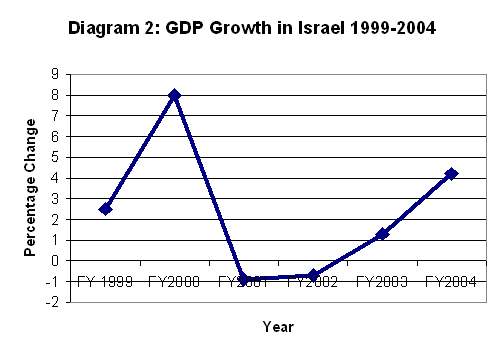
The Impact of Sustained Terrorism on Israel's Economy -- 2000-2004 Changes in the Gross Domestic Product During the period in question, Israel's GDP fluctuated considerably. During 2000, the overall average GDP growth was eight percent (up from 2.5 percent in 1999). Subsequently in 2001, GDP decreased by 0.9 percent in 2001 and by 0.7 percent in 2002. In 2003, GDP growth was a positive rising 1.3 percent and in 2004, increasing to 4.2 percent (see Diagram 2).[4]
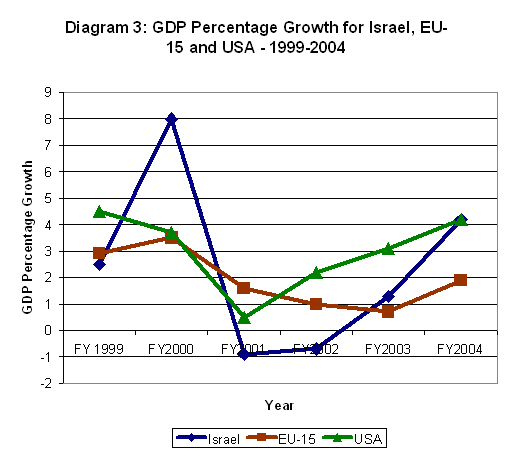
Ostensibly, the striking drop in GDP from 2000 to 2001 was a reflection of the dramatic increase in terrorism. While there can be no doubt that the radically heightened level of terrorism did play some role in this GDP drop, upon closer examination, it becomes clear that other factors--chiefly relating to the global economy--played the primary role. Israel's economy, like most small economies, is highly affected by global economic change. As noted earlier, Israel is particularly affected by economic events that affect its two largest trading partners, the EU and the United States, who in 2003, accounted for 37 percent and 23 percent respectively of Israel's total exports and imports.[5] It is therefore instructive to compare Israel's change in GDP with that of the EU average and of the United States. The average EU-15 GDP for the period rose 2.9 percent in 1999, 3.5 percent in 2000, 1.6 percent in 2001, one percent in 2002, 0.7 percent for 2003, and 1.9 percent for 2004. Hence, we can see that GDP growth for the EU-15 declined in 2001 and stayed low from 2002 through 2004. Similarly, if we look at the data for US GDP growth, we find that GDP growth increased 4.5 percent in 1999, 3.7 percent in 2000, 0.5 percent in 2001, 2.2 percent in 2002, 3.1 percent in 2003, and finally 4.2 percent in 2004. Here too, we can see that the GDP growth rate in 2001 was only a fraction of the growth rate in 1999, and that growth rate began to rise gradually in 2002.[6] Consequently, the pattern of economic difficulties in Israel, at least as far as GDP growth is concerned, somewhat mirrored that in the EU and closely followed that in the United States--as can be seen in Diagram 3 below.
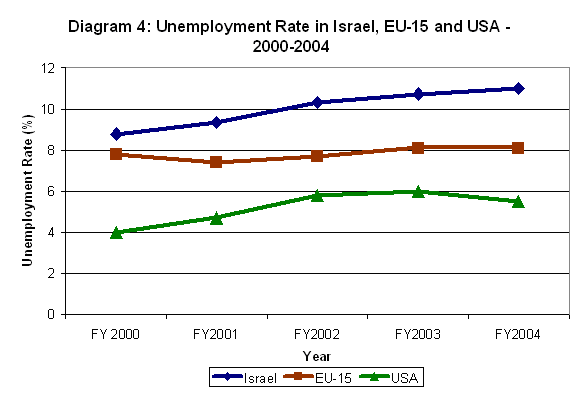
This data therefore suggests that Israeli GDP growth, or the lack thereof, reflected global patterns, particularly with respect to those in the United States. These patterns were characterized by a contraction in capital markets, particularly in the all-important hi-tech industries, and a general global recession. While the United States too experienced massive terrorism on September 11, 2001, this terrorism occurred during the course of one day, was highly localized, and was not considered to have a fundamental impact on GDP growth.[7] The apparent conclusion that must be drawn is not that terrorism had absolutely no impact on GDP growth in Israel, but that it clearly cannot be seen as the main factor when the economies of Israel's main trading partners were also, in differing degrees, in decline. Moreover, the economic downturn was aggravated by the ongoing recession in traditional industries and the governmental budget crisis expressed in an inability to finance many social needs and to continue to support those population sectors that do not contribute to the GDP.[8] Unemployment Levels Between the period of 2000 to 2004, unemployment levels in Israel rose consistently from 8.78 percent in 2000, to 9.33 percent in 2001, to 10.3 percent in 2002, to 10.73 percent in 2003, finally peaking at 11 percent in 2004.[9] While the relative decline of tourism, which is clearly related to the rise in terrorist attacks, produced a rise in unemployment in that sector of the economy, other more substantial sectors of the economy were affected by factors not linked directly to terrorism: in particular, the decline in the NASDAQ (down 60 percent despite a rise after 9/11) and the fact that Israel's main export markets were in the midst of a global recession. Israel's economy continued to be highly dependent on a single sector with hi-tech products constituting 22 percent of Israel's $7.7 billion in exports in 1991, but more than 36 percent of the $18.7 billion in exports in 2000.[10] In 2001, Israeli hi-tech exports declined 20 percent, thus causing grave economic difficulties.[11] The unemployment rates in Europe did not appear to be strongly affected by the global recession--though they did generally rise during the period in question. Unemployment in the United States followed a largely similar pattern to that of Israel, albeit with much more moderate change. In 2000, the unemployment rate for the EU-15 was 7.8 percent, in 2001, the rate was 7.4 percent, in 2002, the rate rose slightly to 7.7 percent, in 2003 it rose to 8.1 percent and stayed at this level in 2004.[12] For the United States, the unemployment rate in 2000 was four percent. In 2001, it rose to 4.7 percent. It rose further in 2002, to 5.8 percent, finally peaking at six percent in 2003, before decreasing to 5.5 percent in 2004 (see Diagram 4).[13]
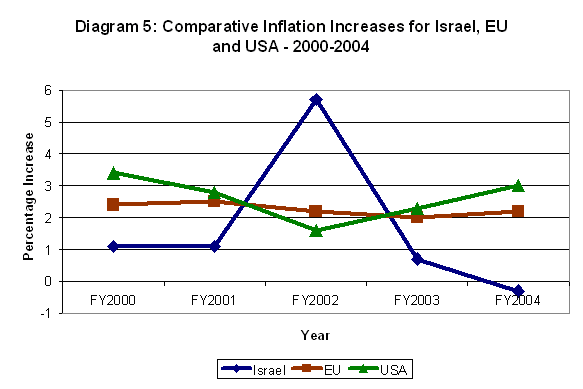
It should be noted, however, that the increase in Israeli unemployment can also be partially attributed to an increase in the labor force (a 1.4 percent increase during the fourth quarter of 2003 alone) due to governmental cutbacks in welfare and unemployment benefits that forced more people into the job market.[14] Hence, much of the rise in unemployment in Israel cannot be attributed directly to the deterioration in the security situation. Inflation Levels Inflation in Israel stayed low during most of the period, jumping briefly in 2002 due to a combination of economic difficulties and interest rate policies. In 2000 and 2001, Israeli inflation increased at 1.1 percent. In 2002, it jumped to 5.7 percent and then dropped to 0.7 percent in 2003. In 2004, the Israeli inflation rate was a negative 0.3 percent.[15] Inflation patterns for the EU countries were generally higher, though they did not suffer from any significant terrorism. In 2000, the inflation rate was 2.4 percent and in 2001 it was 2.5 percent. Inflation was down to 2.2 percent in 2002 and further reduced to two percent in 2003 before subsequently rising to 2.2 percent in 2004.[16] U.S. figures show a 3.4 percent inflation increase in 2000, a reduction to 2.8 percent in 2001, and a reduction to 1.6 percent in 2002. In 2003, inflation increased 2.3 percent and increased to three percent in 2004 (see Diagram 5).[17]
As the graph shows, there does not seem to be any direct
correlation between the brief jump in inflation rates and the onset
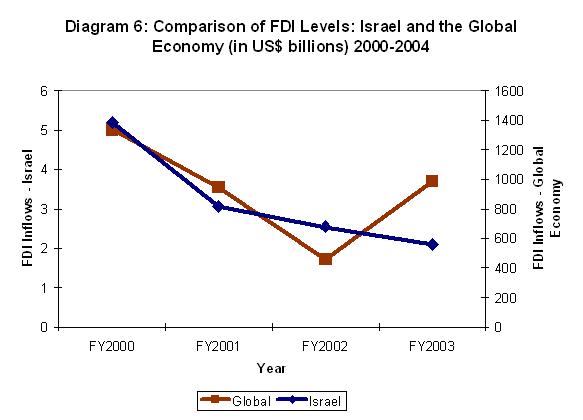
of intensive terrorism in September Foreign Direct Investment During 2000 to 2003, Foreign Direct Investment (FDI) in Israel followed a pattern commensurate with global economic developments. In 2000, FDI flows to Israel stood at $5.01 billion. In 2001, they decreased to $3.55 billion, and in 2002, further decreased to $1.72 billion before rising to $3.7 billion in 2003. Globally, FDI inflows decreased from $1,388 billion in 2000 to $818 billion in 2001 and further decreased in 2002 and 2003 to $679 billion and $560 billion respectively (see Diagram 6).[19]
Hence, once again, while FDI rates were intuitively affected by the deterioration of the security situation in Israel, they were also correlated to global patterns not related to events in Israel. The Stock Market The Israeli stock market (the Tel Aviv Stock Exchange – TASE) reacted negatively both to the rise in terrorism and to the global economic downturn. The Tel Aviv 100 Index rose 3.2 percent in 2000. It then dropped by 16.4 percent in 2001, further dropping by 30.6 percent in 2002. In 2003, stocks recovered, with the TA-100 Index rising by 73.9 percent and further increasing in 2004 by 21 percent.[20] Wall Street's S&P 500 Index for the same time period showed a decline of 11.42 percent in 2000, a further decline of 9.69 percent in 2001, and an additional decline of 5.73 percent in 2002. In 2003, as in Israel, U.S. stocks recovered with the S&P Index rising 8.03 percent and continuing to rise in 2004 by 17.34 percent (see Diagram 7).[21]
As with other economic parameters, the role of terrorism in causing the drop in stock market performance is unclear, particularly when one looks at the context of global economic processes. It appears, however, that once the "cost of terror" is taken into account by investors, markets are able to recover and continue to grow. If we exclude the 19 percent drop in the TASE-100 Index in October 2000 (in reaction to the declaration of the Intifada), the TASE-100 did not fall more than the S&P-500 over a comparable period.[22] Monetary Stability Exchange rate stability is one indicator of the state of the economy with the general expectation being that a weakening currency can lead to economic problems. In 2000, the exchange rate of the New Israeli Shekel (NIS) to the U.S. dollar was at an average of NIS 4.04 to one dollar. In 2001, the Shekel weakened to an average of NIS 4.28 per dollar. The Shekel continued to weaken in 2002, reaching an average of NIS 4.76 to the dollar. In 2003, the Shekel strengthened against the dollar, reaching an average of NIS 4.45 to the dollar. It remained at approximately the same level in 2004, reaching an average of NIS 4.48 to the dollar (see Diagram 8).[23]
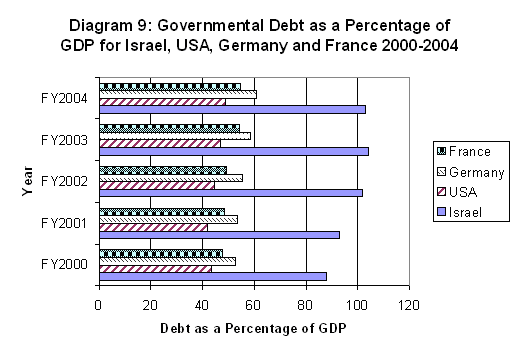
While the shekel did weaken against the dollar during the entire period, it remained within the range of four to five shekels per dollar and thus did not exhibit any severe depreciation, which might be expected to occur in times of severe national crisis. Hence, as with the other parameters, there seems to be no clear correlation between heightened terrorism and severe economic problems. The Government Debt and Changes in Government Defense Spending The level of governmental debt as a percentage of GDP
provides one indication of government spending levels that can rise
in response to terrorism. However, governmental spending may also
rise in response to economic problems, inefficiency in government,
and other factors. Net governmental debt as a percentage of GDP for
Israel during this time period was 88 percent in
By contrast, net governmental debt as percentage of GDP for the United States was 43.3 percent in 2000, 41.9 percent in 2001, 44.5 percent in 2002, 47 percent in 2003, and 48.9 percent in 2004. For Germany, this was 52.8 percent (2000), 53.5 percent (2001), 55.5 percent (2002), 58.7 percent (2003), and 60.8 percent (2004). For France, the corresponding figures are 47.5 percent (2000), 48.2 percent (2001), 49.1 percent (2002), 54 percent (2003), and 54.6 percent (2004).[25] Hence, while U.S. debt increased in 2002 (possibly in part as a result of 9/11), so did German and French debt ratios--and neither of these countries had to cope with a serious terrorist attack (see Diagram 9).
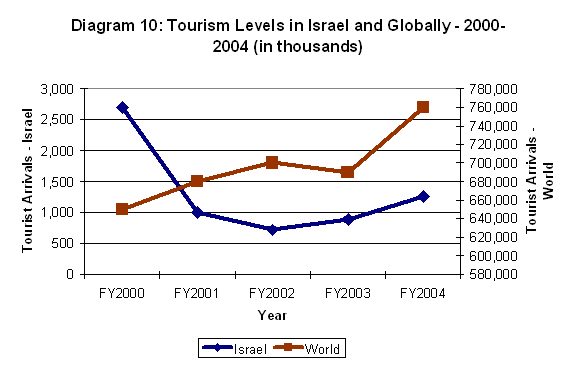
Moreover, in 1995, at the height of the Oslo peace process and at a time when terrorism levels were much lower, Israel's ratio of governmental debt to GDP was 106 percent. Consequently, increased governmental borrowing is not necessarily related to the degree of terrorism. In the area of government expenditures on defense, one would expect to see a direct correlation between a rise in terrorism and defense spending designed to meet the increased threat. Indeed, this correlation does exist, but it is unclear as to the degree to which it exists. Between the period of 2000 to 2004, defense expenditures in Israel rose from nine percent to twelve percent of GDP.[26] There can be no doubt that the intensive terrorism directed at Israel contributed to this increased expenditure. However, as the Israeli Ministry of Defense does not provide publicly available information on the breakdown of the defense budget, it is impossible to know how much of this increase was due to funding of anti-terror activities. Despite this problem, one can reasonably speculate that some of the rise in defense expenditures had to do with the development of other security threats not directly related to the Israeli-Palestinian conflict. The time period in question immediately followed a series of successful Iranian tests of the Shihab-3 missile--a weapon with a range of 1,300 km capable of delivering non-conventional warheads to all regions of Israel. Indeed, Israel's development of the Arrow anti-ballistic missile (though funded significantly by the United States) was stepped up during this time, and a major test was conducted in January 2003 (testing the system's ability to launch multiple missiles at different targets). Israel also spent money on increasing its navy's capacity to project power, and in early 2004, its air force received the first shipment of the 100 F-16I fighters that Israel ordered from the United States (and paid for only in part with U.S. military aid). Needless to say, these hardware requirements (designed for coping with regional threats) are extremely expensive and could outweigh the costs of the generally less expensive equipment used in anti-terror operations (attack helicopters, APCs) as well as the cost of added personnel to be used in anti-terror duties. To provide another example of non-terror related spending, retirement payments provided to ex-military personnel also increased by 3.5 percent during this period, thus adding to the defense burden. Consequently, in light of these and other costs, the significant rise in defense spending was not exclusively due to the terror threat. It is, moreover, conceivable that a significant proportion of this spending increase was not related to the terrorism issue. The Health of the Tourism Sector It is generally accepted that there is a high correlation between terrorism and the decline of tourism (in the form of cancellations of tours, hotel bookings, and the like). At least one study has suggested that terrorism had only a modest effect on the Israeli hotel industry. This is primarily because foreign tourists tend to spend much time in parts of the country, save Jerusalem, not directly associated with terrorist violence.[27] Nevertheless, foreign tourist arrivals declined sharply from an all-time high of 2.7 million tourists in 2000 to 996,000 in 2001 and finally bottoming out at a paltry 718,000 in 2002. In 2003, the number of tourists entering Israel rose moderately to 886,000, and then significantly in 2004, to 1.25 million.[28] Globally, world tourism grew slowly from approximately 650 million tourist arrivals in 2000, to some 680 million in 2001, further increasing to 700 million in 2002. In 2003, world tourist arrivals dipped to some 690 million before increasing dramatically in 2004, to 760 million (see Diagram 10).[29]
Therefore during this time period, global tourism increased, albeit sluggishly (most likely due to the lackluster state of the global economy), while tourism to Israel sharply declined. Hence, it appears that this sector of the economy was significantly affected by the rise in terrorism. It should be taken into account, however, that the low level of tourism in late 2002 and early 2003 can also be attributed to the events leading up to the Iraq War, in which Israel was perceived to be a potential target. Despite the sharp rise in terrorism and the Iraq War, domestic tourism (that is, Israeli tourists touring Israel), which accounts for approximately 65 to 70 percent of tourism revenues, was not adversely affected. Consequently, out of the approximately three to four percent of Israel's GDP based on the tourism industry, terrorism only substantially affected a fraction of this (accounting for one to 1.5 percent of Israel's GDP).[30] The Impact of Sustained Terrorism on Israel's Society, 2000-2004 Popular Sense of Security Gauging the true impact on the well-being of Israeli society and Israeli individuals of living in the shadow of heightened terrorism is probably an impossible task, particularly in regards to long-term impacts. However, one can look at empirical evidence such as public opinion polls to get some sort of quantitative indication of how Israeli society (and individuals) fared during four years of ongoing violence. Granted, public opinion polls are not objective indicators of anything, but they do give a sense of how people feel, and political realities are largely based on how decision makers and/or members of the public perceive reality. One public opinion poll, carried out by the National Security Studies Center at the University of Haifa, found that in October 2000, 80 percent of Israeli Jews polled declared that they feared terrorist attacks against themselves or close family members. In April 2004, that figure remained high standing at 75 percent of Israeli Jews polled.[31] In another poll, Jaffee Center for Strategic Studies researcher Asher Arian found that the percentage of respondents that were very worried about the security situation declined from 63 percent in 2002 to 40 percent in 2003. He also found that the percentage of respondents who labeled the "general condition of the country" as being "poor" declined from 46 percent to 26 percent over the same time period.[32] These polls thus provide an overall picture in which the average Israeli citizen became comparatively less fearful of terrorism and more confident that things were improving in the country as time progressed. Moreover, citizens' faith in the Israeli security forces remained high (92 percent evidencing faith in the security forces in 2000, and 90 percent evidencing similar faith in 2004).[33] Popular Support for the Government and its Security Policies Measuring popular support for the government and its security policies provides us with an additional indication as to whether or not the population feels that the government is working to increase security and will eventually succeed in doing so. However, one must keep in mind that on this matter, as with others, drawing unambiguous conclusions is not truly possible. For example, according to the findings of one Israeli public opinion poll, in 2001, 33 percent of respondents felt that the Israeli government was doing a good job, whereas in 2003, only 22 percent of respondents felt the same way.[34] While this would suggest decreased popular support for the Israeli government and its policies, one must keep in mind (especially considering the high degree of faith exhibited by respondents in the efficacy of the security forces) that this may reflect general malaise, economic decline, and dissatisfaction with governmental policies in other areas (particularly since, in Israel, criticism of the government is practically a national sport). Another, perhaps more reliable, indicator that we can examine is election results. Since security matters constituted a focal point in the elections of January 2003, the outcome of the elections, which propelled the ruling Likud party of Prime Minister Ariel Sharon to its greatest election victory of all time, constitutes a fairly good indicator of popular satisfaction with governmental security policies. In the 2003 elections, the Likud won 38 seats in the Israeli Parliament (which rose to forty with the post-election addition of a small immigrant party to the Likud), while its rival, the Labor Party, with 19 seats, suffered its single worst electoral showing. As the Likud was generally associated, in the popular mind, with taking a hard line on terrorism and Labor with a more conciliatory line towards the Palestinian Authority (despite the fact that many of Israel's large anti-terrorist operations were conducted during the existence of a Likud-Labor national unity government when the minister of defense was a member of Labor), the massive Likud victory can only be interpreted as evidence of popular confidence in the activist policies of the government. Psychological Well-Being A landmark Israeli psychological study conducted in April-May of 2002, found that while 58.6 percent of respondents reported feeling depressed about the security situation, only 9.4 percent were found to be suffering from Post-Traumatic Stress Disorder (PTSD). Moreover, 82.2 percent reported feeling optimistic about their personal futures, and 74.6 percent believed that they would be able to function in a terrorist attack. In perhaps the most telling finding of the study, only 5.3 percent of respondents indicated that they had sought professional help due to anxiety. The authors of the study concluded that the psychological impact of the sustained period of terrorism could be considered moderate and that people had developed strong psychological habituation and coping mechanisms to deal with the realities of terrorism.[35] Another study examined the occurrence of PTSD among terror attack victims three months after they experienced a terrorist attack and found that only 13 percent met the criteria for sufferers of PTSD, while 43.5 percent showed no long-term psychological effects.[36] The aforementioned discussion should not create the impression that terrorism has not affected Israeli society. During the peak period of terrorist attacks, some 40 percent of Israeli children were found to be suffering from Post-Traumatic Stress Disorder. Yet another study found that 56 percent of adults surveyed (both in high threat areas and in comparatively safer areas of the country) exhibited a high level of stress related to the security situation, with over 80 percent of respondents noting that they had checked up on the safety of family and friends in the wake of terrorist attacks.[37] Hence, while--intuitively speaking--terrorism must have had an unquestionable impact on Israeli society, that society did not exhibit anything close to the sort of mass collapse that might have been expected and has proven resilient in coping with the decline in personal security. CONCLUSIONS In light of the economic data and that related to societal issues, it appears clear that despite the high level of terrorism that Israel's economy and society were forced to cope with between the years 2000 and 2004, the overall economic and social impact was not exceptionally significant. Although nearly as many Israelis died as a result of terrorist attacks between 2000 and 2004 as had been killed by terrorists between 1948 and 2000, Israel's economy and society were not plunged into crisis. Much of the economic downturn that Israel experienced during this period can be attributed to factors exogenous to the Israeli-Palestinian conflict. Israeli patterns of GDP growth, unemployment, foreign direct investment, and stock market performance were fundamentally similar to those among Israel's main trading partners. Overall, the Israeli economy did not suffer from pronounced inflation (with the exception of a brief period related more to monetary policies and global economic processes than to security concerns), and Israel's currency was largely stable. Governmental debt increased in the early part of this period and governmental spending on defense increased significantly, but this was in response to a variety of factors of which the heightened level of terrorism was only one. Even tourism was only partially impacted by the rise in terrorism, due to the fact that domestic tourism was largely unaffected. In the societal arena, the increase in terrorism did not significantly lower public morale, create cleavages between the government and the society, reduce the citizens' faith in the security forces, or lead to a reduction in support for the government and its policies (in fact, the opposite occurred). The increased terrorism did not even succeed in psychologically breaking the survivors of terrorist attacks. Terrorism is clearly a threat to human life and represents a certain threat to the social and economic order. It must be combated with all the resources of the state, because it is the role of the state, first and foremost, to provide for the security of its citizens. At the same time, overestimating the impact of terrorism on the society and economy of a given country may result not only in a misallocation of resources, but could provide the terrorists with a psychological victory and enhanced prestige through overestimating their importance and their impact. This enhanced prestige may result in greater recruitment potential, provision of more financial support and the creation of new sources of revenue, provision of greater popular support, enhanced political power, and other benefits for the terrorist organization. Consequently, overestimating the impact of terrorism may prove as dangerous and deadly as underestimating its impact. *Nadav Morag is Chair of the Political Science Department at the University of Judaismand adjunct professor at the Naval Postgraduate School. NOTES [1] Robert Looney, "Economic Costs to the United
States Stemming from the 9/11 Attacks," (Monterey: Center for
Contemporary Conflict, Naval Postgraduate School, 2002), [2] Don Radlauer, AnEngineered Tragedy: Statistical Analysis of Casualties in the Palestinian-Israeli Conflict, September 2000 – September 2002 (Herzliya: International Policy Institute for Counterterrorism, 2002), pp. 2-8. [3] Israel Television Channel 1, Mabat, Evening News, July 11, 2004 (in Hebrew). [4] Bank of Israel Research Department, "Main Israeli Economic Data" (Jerusalem: Bank of Israel, December 2004). [5] Central Bureau of Statistics, "Trade Countries by Countries and Country Group" (Jerusalem: Central Bureau of Statistics, 2005), http://www.cbs.gov.il/fr_trade/td3.htm. [6] European Commission, "Statistical Annex: Employment in Europe 2004," (Brussels: European Commission, 2005), http://europa.eu.int/comm/employment_social/employment_analysis/eie/eie2004_stat_annex_en.pdf. [7] Gail Makinen, "The Economic Effects of 9/11: A Retrospective Assessment" (Washington, D.C.: Congressional Research Service – Report for Congress, September 27, 2002), p. 2. [8] Imri Tov, "Economy in a Prolonged Conflict: Israel 2000-2003," Jaffe Center for Strategic Studies - Strategic Assessment, Vol. 6, No. 1 (May 2003), pp. 3-4. [9] Econstats, "Unemployment rate, Israel"
(Econstats, 2005), [10] Sam Vaknin, "Israel's Hi, Tech--Bye Tech," United Press International, January 25, 2002. [11] Yossi Greenstein, "The Global Recession, the NASDAQ Crisis and the Continuing Intifada Have Killed the Israeli Economy," Ma'ariv Weekend Supplement, March 15, 2002, p. 42. [12] Eurostat, "Total Unemployment Rate" (Brussels:
Eurostat, 2005), [13] US Department of Labor, "Labor Force Statistics
from the Current Population Survey" (Washington, D.C.: Bureau of
Labor Statistics, 1995), [14] Bank of Israel Research Department, "Recent Economic Developments – 105: October 2003 to March 2004" (Jerusalem: Bank of Israel, 2004), p. 6. [15] International Monetary Fund (IMF), "World
Economic Outlook Database," (Washington, D.C.: International
Monetary Fund, 2004), [16] IMF, "World Economic Outlook Database,"
(Washington, D.C.: International Monetary Fund, 2004), [17] IMF, "World Economic Outlook Database,"
(Washington, D.C.: International Monetary Fund, 2004), [18] Bank of Israel, "Recent Economic Developments –
April 2002 – December [19] United Nations, "Country Fact Sheet: Israel" (New York: United Nations Conference on Trade and Development, Division on Investment, Technology and Enterprise Development, 2004). [20] Tel Aviv Stock Exchange, "Main Indicators of the Equities Market, 1992-2004" (Tel Aviv: The Tel Aviv Stock Exchange, 2005), http://www.tase.co.il/TASEEng/Statistics/AnnualTables/T01-Equities.htm. [21] Standard & Poor's, "S&P Annual Returns"
(New York: Standard & Poor's, 2005), at: [22] David Simons, "Cold Calculation of Terror,"
Forbes.com, May 28, 2002, [23] Central Bureau of Statistics, "Exchange Rate of the Israel Sheqel Against the US Dollar" (Jerusalem: Central Bureau of Statistics, 2004), http://www1.cbs.gov.il/shnaton55/st17_13.pdf; "Shekel Strengthened 1.5 Percent against US Dollar in 2004," Globes Online, January 3, 2005, http://www.globes.co.il/DocsEn/did=870168.htm. [24] Ministry of Finance, "Internal and External
Government Debt in Percent of GDP 1005- [25] IMF, "General Government Net Debt in Percent of
GDP" (Washington, D.C.: International Monetary Fund, 2005), [26] Zvi Eckstein and Daniel Tsiddon, Macroeconomic Consequences of Terror: Theory and the Case of Israel, Discussion Paper No. 3-2004 (Tel Aviv: Pinhas Sapir Center for Development, Tel Aviv University, January 2004), p. 4. [27] Aliza Fleischer and Steven Buccola, "War, Terror and the Tourism Market in Israel," Applied Economics, Vol. 34, No. 1 (July 2002), pp. 1335-39. [28] Government of Israel, "Budget of the Government of Israel, FY 2005: Main Economic Developments" (Jerusalem: Government of Israel, 2005), p. 47 (in Hebrew); Bank of Israel, "Main Israeli Economic Data: Foreign Tourism to Israel" (Jerusalem: Bank of Israel, 2005), http://www.bankisrael.gov.il/deptdata/mehkar/indic/eng_c11.htm. [29] World Tourism Organization, "News Release:
International Tourism Obtains its Best Results in 20 Years" (Madrid:
World Tourism Organization, 2005), [30] Ezra Sadan, "How is Israel's Economy Affected by the Security Situation?" Jerusalem Issue Brief, Vol. 4, No. 11, (December 2004), http://www.jcpa.org/brief/brief004-11.htm. [31] Gabriel Ben-Dor, TheSocietal Component of National Resilience (Haifa: National Security Studies Center, University of Haifa, 2004) (in Hebrew). [32] Asher Arian, Israeli Public Opinion on National Security 2003, Memorandum No. 67 (Tel Aviv: Jaffee Center for Strategic Studies, Tel Aviv University, 2003), p. 20. [33] Ben-Dor, TheSocietal Component of National Resilience. [34] Arian, Israeli Public Opinion on National Security 2003. [35] Avraham Bleich, Marc Gelkopf, and Zahava Solomon, "Exposure to Terrorism, Stress-Related Mental Health Symptoms, and Coping Behaviors Among a Nationally Representative Sample in Israel," Journal of the American Medical Association, Vol. 290, No. 5 (August 2003). [36] Ornah T. Dolberg, Shaul Schreiber, Leor Agnes, Helna Rapoport, and Miki Bloch, "The Prevalence of PTSD Among Survivors of Terror Attacks – A Report of 129 Cases," Presented at the Israeli Psychiatric Association Annual Meeting, Haifa, April 2003. [37] Irwin J. Mansdorf and Jacob Weinberg, "Stress Reactions in Israel in the Face of Terrorism: Two Community Samples," Traumatology, Vol. 9, No. 3 (September 2003), pp. 160-61. MERIA Journal
Staff *Serving
Readers Throughout the Middle East and in 100 Countries* |