
|
Published by the GLORIA Center, |
Volume 11, No. 3, Article 4/9 - September
2007 |
|
|
At times of peace, Germany’s Middle East policy has historically taken a secondary position—one subordinate to Germany’s primary policy toward Europe and America. While of secondary importance, it was a tool that could be used to manipulate the Middle Eastern Question by playing off Western powers against each other. Berlin’s goal was a peaceful penetration of the Ottoman Empire, and it had no colonial aspirations in the region. During the world wars, however, Berlin elevated its Middle East policy to primary status by instigating jihad in the enemy’s hinterland. Yet in recent years, Berlin has sought out policies on Middle East peace and Islam fitting the European framework.(1) GERMAN MIDDLE EAST EARLY YEARS When the German Reich was established in 1871, the neighboring countries of Great Britain, France, and Russia were already expanding their overseas colonies into empires. During the next four decades, while these empires continued to grow, Berlin was forced to develop a policy toward North Africa and West Asia that differed from those of the other European powers.(2) By the time Germany was founded, there was nothing much left in the region to be claimed. The territories that became known as the Middle East had already been distributed among Germany’s neighbors. Thus, maintaining the status quo in the region was most likely to have served Germany’s national interests.(3) Trade, commerce, and peaceful penetration—especially in open-door areas—were the cornerstones of Berlin’s Middle East policy. This was also true during the Deutsche Orient-Gründerjahre, or the “German Orient founding years,” beginning in 1884 and lasting three decades.(4) During this period, Germany explored new regions in Africa and Asia. Berlin established colonies in West and East Africa, becoming a small colonial power.(5) However, it was also an era during which the Germans intensified their economic, cultural, and military relations with the Middle East—whose vast lands ranged from Turkey via Palestine and Mesopotamia to Egypt and Mauritania. The first striking feature of Berlin’s peacetime Middle East policy thus appeared: respecting the status quo and refusing to create any colonies in the region.(6) Furthermore, the Eastern Question—who would get which part of the declining Ottoman Empire—had caused many conflicts. It was Chancellor Otto von Bismarck—until 1890 the main foreign politician with a distaste for colonial acquisitions—who regarded the Eastern Question as a means for his policy toward Germany’s neighbors in Europe. He opined that policy toward Europe and America came first, and policy toward the Middle East had to serve this primary policy. Thus, and this is the second feature, Berlin’s Middle East policy was always subordinated to a primary policy toward Europe and America.(7) Third, the Middle East was not promising enough to merit a grand design for German policy. As Otto von Bismarck said, “The Eastern Question is not worth the bones of a single Pomeranian musketeer.” For example, the German policy toward Egypt at the time was considered a question not between Berlin and Cairo, but between Berlin and London. In the chancellor’s eyes there was not much to expect from direct relations with Egypt, but Egypt made an effective “stick”(8) to be used against London to disturb some alliances between Germany’s neighbors. He used this bâton égyptien diplomatically. Since Berlin had no colonies in the region, it slipped into the role of a key mediator in European conflicts over the Orient. Thus, the third striking feature of Berlin’s Middle East policy was a diplomacy of mediation, namely during a series of conferences on African frontiers and Asian topics beginning in the 1880s.(9) The three features of Berlin’s policy toward the Middle East in peacetime were: respecting the status quo and renouncing territorial claims in the region; the subordination of this secondary policy to the primary policy toward Europe and America; and the diplomacy of mediation in Oriental conflicts. Unlike the other great powers, Germany did not rule over any Muslims in the Middle East.(10) Therefore, the Germans gained a critical perspective on their neighbors’ Middle Eastern empires and all the troubles they had caused. It is no wonder that mainstream German politicians and academics had a sympathetic view of anti-imperial tendencies and their nationalistic or Islamic expressions. JIHAD MADE IN GERMANY Soon, the long-feared “Sarajevo effect” dragged Europe and the world into a war starting in the peripheral Balkans. The unique feature in Berlin’s switch from a secondary peacetime Middle East policy to a primary wartime policy against Great Britain, France, and Russia (and the colonial Middle Eastern hinterland) was that the jihad was “made in Germany.(11)” This had already become an issue during the first year of the war. A dispute between the two founding fathers of the study of Islam in Europe erupted. Their discussion indicated that the general attitude toward the war was at first frenetically welcomed and expected to be very short. Did the Germans push the Young Turks to proclaim jihad after entering World War I against the British, the Russians, and the French? Indeed they did, maintained the leading Dutch Arabist, C. Snouck Hurgronje, who blamed his German colleagues—among them Carl Heinrich Becker—for having supported this “jihad fever.” The Dutchman insisted this jihad was an intellectual weapon that had been “made in Germany.” Supposing this were true, replied the German scholar of Islam, had not Berlin and Istanbul every right to do so? Yet this, wrote Hurgronje, hurts humanism and religious peace. “There is no taboo for religion,” Becker answered.(12) Jihad developed as a concerted German-Ottoman campaign. It consisted of five stages: Max von Oppenheim’s design to revolutionize the enemy’s colonial hinterland; the instigation of jihad by the Berlin-based Oriental News Department; the Ottoman fatwa (religious edict); Shaykh Salih’s commentary on the fatwa; and the realization of jihad. Jihad was used as a weapon to globalize the war. However, it was a slap in the face to the Enlightenment. Although Hurgonje’s criticism hit the mark, Becker maintained a chauvinistic approach. To understand Germany’s Middle East policy, it is worthwhile to look into these five elements of jihad according to the German design. Max von Oppenheim had served as an archaeologist and diplomat in the Middle East for 20 years. Wilhelm II read Oppenheim’s reports recommending jihad.(13) After the war began, German General Chief of Staff Hellmuth von Moltke wanted Enver Pasha to proclaim jihad in order to weaken the enemies from within. The kaiser asked him to enter the war too: He wanted the sultan to call for jihad in Asia, India, Egypt, and Africa to enlist Muslims to fight for the Caliphate. Berlin and Istanbul cooperated closely in planning and realizing the jihad. There were even some academics in Berlin who expected to see “Islamic fanatics fighting for Germany.(14)" Invoking jihad was the idea of Max von Oppenheim, the German “Abu Jihad.” In late October 1914, before the Ottomans had entered the war (siding with the Central Powers), he designed a master plan “fomenting rebellion in the Islamic territories of our enemies.(15)” The emperor confirmed Oppenheim’s suggestion to incite Muslims—potentially those in British India, French North Africa, and Russian Asia—to jihad under the leadership of the Ottoman sultan-caliph. The call to fight would be announced in several languages. The sultan was to proclaim jihad against the British, French, and Russians, while Berlin would provide money, experts, and equipment. In addition, Berlin would establish an Oriental News Department in its Foreign Office. Muslim rebellion in India, however, was the key to victory. Expeditions were to be sent to Afghanistan to trigger an uprising there.(16) The Germans would provide intelligence to the Muslims, while the Turks would incite them to rise up against their foreign masters. Islam, concluded Max von Oppenheim, would be one of Germany’s sharpest weapons against the British. He believed Germany should mount a joint effort to make it a deadly strike.(17) Max von Oppenheim (later succeeded by Karl E. Schabinger and Eugen Mittwoch) was made head of the Oriental News Department. Oppenheim employed a dozen academics and native Muslims. Some called his strategy of jihad a “war by revolution.(18)” Yet it was an asymmetrical war, waged by incitement to jihad and by anti-imperial uprisings. The aim was a double strategy using both the direct fighting on the front lines and an effort to raise revolts in the colonial hinterland to keep enemy troops busy putting them down. Of course, the strategy raised some questions. Did all Muslims accept the Ottoman sultan as caliph? Were Muslims permitted to fight with infidels against other infidels and “their” Muslims? As Max von Oppenheim had suggested, a fatwa provided the answer. The Shaykh of Islam declared five points on November 11, 1914.(19) In brief, after the enemy of Islam had attacked the Islamic world, His Majesty the Padishah of Islam would order a jihad as a general mobilization and as an individual duty for Muslims worldwide, in accordance with the Koran. With Russia, England, and France hostile to the Islamic Caliphate, it would also be incumbent upon all Muslims ruled by these governments to proclaim jihad against them and to actually attack them. The protection of the Ottoman Empire would depend on Muslim participation in the jihad, and those refraining from doing so would be committing a horrible sin and would deserve divine wrath. It would be absolutely forbidden for Muslims of the named enemy countries to fight against the troops of Islamic lands and they would be deserving of hellfire for murder, even if the enemies had forced them to do so. It was also declared a great sin for Muslims under the rule of England, France, Russia, Serbia, Montenegro, and their allies to fight against Germany and Austria, the allies of the Supreme Islamic Government. According to this fatwa, the sultan-caliph had sovereignty over all Muslims. They were permitted to fight with infidels against infidels and “their” Muslims. The latter not only had no right to fight back, but had to turn against their foreign overlords. Shaykh Salih al-Sharif al-Tunisi backed the Austro-German Central Powers’ new doctrine of jihad. Enver Pasha had asked Shaykh Salih to travel to Berlin to promote the idea of jihad among the Germans. For this purpose, Shaykh Salih wrote a commentary entitled Haqiqat al-Jihad (The Truth of Jihad), which was published in early 1915 by the German Society for the Study of Islam. Martin Hartmann of the Seminary of Oriental Languages in Berlin wrote a friendly foreword and the dragoman Karl E. Schabinger added an afterword. Both recommended the text as a “development of jihad.” This referred to possibility of a “partial jihad”: the allied infidels against certain enemy infidels alone. This jihad was an individual duty for all Muslims. A peace between the world of Islam and Europe would be possible if foreign occupation of Islamic lands were to come to an end.(20) In the end, the execution of the jihad was disappointing for Max von Oppenheim and his Oriental News Department in the Foreign Office. The majority of Muslims seemed to ignore the call to jihad despite the vast sums of money the Germans had invested in expeditions (for example, the expedition to Kabul headed by Werner Otto von Hentig and Oskar von Niedermayer) and pan-Islamic propaganda printed in Berlin (such as the weekly al-Jihad). Nevertheless, Schabinger concluded that the seeds of an uprising had been planted. He posited that one day there would be an accumulation of colonial people ready to turn against their rulers.(21) The German general staff drew a much less favorable conclusion; they believed that the notion that jihad would decide the war was an illusion.(22) On the opposing side, as early as mid-1916, a French source concluded that the declarations of jihad had moved many people to act in the name of Islam: “They failed, indeed, but they caused no end of trouble to the Entente Powers.(23)” Indeed, this jihad was viewed as a concerted German-Ottoman action. Planned as an export of an Islamic uprising or revolution into the enemy’s colonial hinterland, the idea was truly made in Germany. It was rather unfortunate that renowned German Oriental experts such as Carl Heinrich Becker, Martin Hartmann, Ernst Jäckh, and Max von Oppenheim unleashed the old genie of pure religious hatred. Others, like C. Snouck Hurgronje, remained steadfast against this use of jihad and defended basic values of humanism and enlightenment. The most distinctive features of Berlin’s Middle East policy during World War I were not the 30,000 German troops fighting as part of the Ottoman army, the two attempts to capture the Suez Canal, or General Hans von Seeckt’s role as the last Ottoman chief of staff. Of course, from a Middle Eastern viewpoint, the foremost element was that the Ottomans sided with the Germans.(24) What was unique was that after the switch from a secondary policy of maintaining peace to a primary war policy, the jihad was “made in Germany.” Thus, the German discipline of Islamic study lost its innocence not long after its birth. THE REPUBLIC OF WEIMAR RETURNS TO A SECONDARY MIDDLE EAST POLICY After the Germans had lost the war and had overthrown their emperor and his “world policy,” the German Reich no longer remained a monarchy but became the Republic of Weimar. As such, a Germany that had lost a third of its size was bound to comply with the victors’ demands. Reconstruction and reform were the order of the day. Thus Berlin returned to its secondary Middle Eastern peace policy. In accordance with the Treaty of Versailles, Germany lost its Central African colonies. The new republic was even freer to concentrate on trade, commerce, and culture, reestablishing two of the prewar pillars of the German policy toward the Middle East. This included respecting the status quo and disclaiming any territories. The third pillar, mediating in Oriental disputes, was excluded since Germany was given no role in international relations at all, a fact that promoted thoughts of vengeance in Berlin. In the early 1920s, the Foreign Office made reforms, thus breaking away from older traditions. Both the classical diplomat of noble descent—trained in jurisprudence— and the dragoman—conversant in Oriental languages as well as in judicial matters—were replaced by a wider range of experts from all disciplines. Thus Berlin managed to regain most of its lost positions, and once again became the third-ranking country in foreign trade with the Middle East. One question that was often discussed in Berlin was whether or not to support industrialization in the region. Ultimately, the argument that prevailed was that if Germany did not do so, competition would take over this business. The Germans were attractive partners, especially for Middle Eastern nationalists in newly emerging countries such as Saudi Arabia and Iraq who sought out alternative suppliers. Students from the Middle East who had studied in Germany since 1920 returned to their homelands and advanced there professionally. They favored Germany in a climate that had become hostile to the new British and French mandatory powers.(25) The Republic of Weimar applied a secondary Middle East peace policy, cautiously avoiding trouble with London and Paris. Nevertheless, the Germans remained very critical of the declining empires in the region35 and supported Arab nationalists in their desire to rid themselves of foreign masters. In light of this, there was a natural basis for cooperation between the Germans on the one hand, and the Arabs, Turks, and Persians on the other. It was not difficult for the old diplomatic guard, among them Dr. Fritz Grobba(26), to exploit the feelings created by having fought and lost on the same side in the war. As a result of the Treaty of Versailles, Berlin possessed no navy or other military tools, and thus had a diminished interest in the Middle East. Apart from economic and cultural relations, the region lacked importance for Berlin and returned to playing a marginal role. London had decided to support a Jewish homeland in Palestine. As the waves of new Jewish immigrants, olim chadashim, arrived there, Palestine became a focal point. Berlin tried not to get involved in this project and kept its distance. Nevertheless, anti-Semitism was on the rise in Germany and did influence the fate of the region, though initially only indirectly. Moreover, some politicians in Berlin saw the emigration of Jews to Palestine as the solution to problems of Central Europe. However, the most dangerous development was that advanced Jewish assimilation in Germany was in jeopardy, and with it some of the most important results of the European Enlightenment. Throughout the 1920s, German racism rose to the surface. What occurred in the following decade was in no way a surprise. Even founding fathers of Islamic studies such as Carl Heinrich Becker had tended to divide humankind into “higher” and “lower” races. NAZI GERMANY’S SECONDARY AND PRIMARY MIDDLE EASTERN POLICIES From his election in 1933 until World War II, Adolf Hitler pursued a secondary Middle East peace policy. He was much more interested in a division of labor with London. He thus accepted the British Empire while believing that Eastern Europe should be a completely German domain for Lebensraum. He readily left political “responsibilities” for the Middle East to the Soviets, Great Britain, and Italy.(27), maintaining the tradition established by the first chancellor, Otto von Bismarck, who had regarded colonial outposts in Africa and Asia as nothing but trouble. Hitler’s racial views, made public in 1920, must have influenced his lack of interest in creating German colonies or territories in the lands of “colored people.” An examination of German Middle East policy under Hitler confirms that the region was of no concern to him. He built a Berlin-Rome axis with clear functions for Italy in the Middle East and hoped for an understanding with London. Arab nationalists such as Grand Mufti Amin al-Husayni of Jerusalem were more interested in him than vice versa. An additional factor on the German side was the shortage of funds, as most of the money was being spent on rearmament. All this could be changed by three factors. First, if a disagreement or war were to arise with London, Paris, or Moscow, the Middle East could become a major battleground. For this reason, German planners were interested in the French and British-influenced territories as well as Russia’s immediate neighbors (such as Afghanistan and Turkey), even in peacetime. Franz von Papen was soon made Hitler’s ambassador to Ankara, showing the importance Hitler accorded Turkey. Second, the Middle East could become a primary matter if the positions of Axis partners such as Italy and Japan were in danger. Berlin could then be dragged into conflicts. A common German policy was to avoid such risks in a region of secondary importance. The Middle East was not even important to Germany as a source of raw materials. Instead, Germans relied on Europe for raw materials, including oil from the Balkans, tungsten from Portugal, and chrome ore from Turkey. There was no need for deliveries from the Middle East or for military bases there. The third possibility for increasing Berlin’s interest in the Middle East was in case the plan of Blitzkriege (“lightning wars”) in Europe failed. In that event, the region would become more important as a battlefield tying down as many enemy troops as possible, as a source of allies in the form of local revolts, and as a base for attacking Russia or blocking British access to the Suez Canal. Thus, the concept of a “jihad made in Germany” again became important. Yet Hitler, of course, did not expect it to be needed. The region was to be reserved primarily for the Italians. The Germans and Japanese had only economic interests. Accordingly, the Tripartite Treaty of Berlin codified the areas of influence a year after World War II had begun. After Germany started World War II in September 1939, all three of the above scenarios played out. Hitler did not achieve an agreement with London, and instead, a war against Great Britain commenced. Most British-influenced countries, such as Egypt, broke off their relations with Berlin at the beginning of World War II. Taking matters a step further, they declared war on Germany shortly before its end. Berlin then switched from a secondary policy of Middle East peace to a primary policy of Middle East war. Although this new policy was directed against London, Berlin played no major role in the Middle East, as it had to take the Italian policy in the region into account. In mid-1940, after the fall of France, the Middle East became more accessible for the Germans. However, Hitler showed no interest in the French colonies.(28) Again, he concentrated on continental Europe. In the most critical period of World War II, from June 1940 until November 1942 (see Map 1), Hitler regarded the Middle East as a potential battleground, but never as a field of a greater engagement—a position that only a victory against Russia could have changed. In preparation, his Order Number 32 called for Germany’s plans in the Middle East to pave the way for subsequent battles against the British. There too he would inflict an “uncompromising war against the Jews.” Furthermore, as he explained to the Grand Mufti of Jerusalem at the end of November 1941, this relentless war would naturally include an active opposition to the Jewish national homeland in Palestine. Germany would be “willing to solve the Jewish problem step by step and it would appeal at the proper time to non-European nations as well.(29)” The current battle against the “Judeo-Communist Empire in Europe” would decide the fate of the Arab world as well. He hoped that the coming year would make it possible for Germany to thrust open the Caucasian gate to the Middle East, but his Blitzkrieg failed at the Stalingrad front in November 1942.(30) That same month, General Erwin Rommel lost the Battle of al-Alamayn, an attempt to reach the Suez Canal. The Allied forces landed in Morocco and Algeria, and Hitler’s plan had failed.
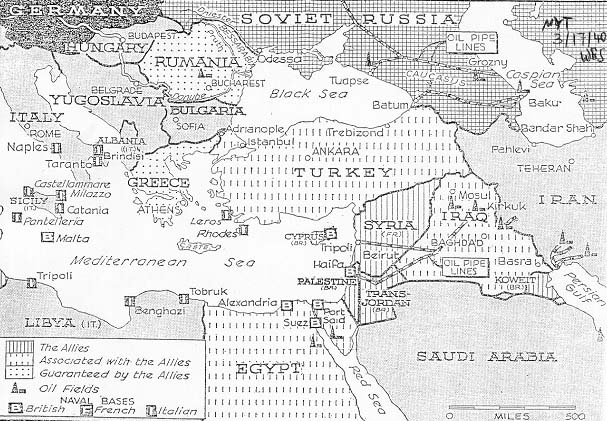
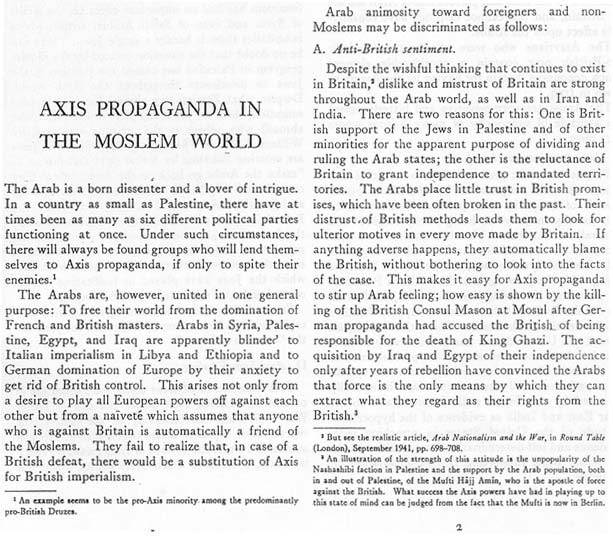
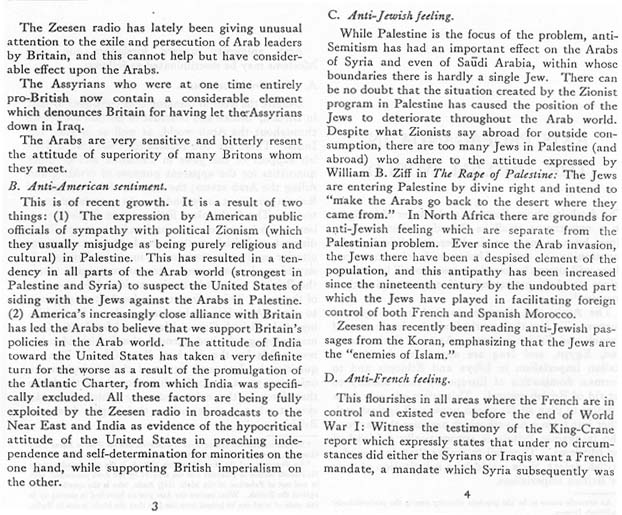
Map 1. Mid-1940 and 1942, the most critical time for the Allied forces in the Middle East. (Source: New York Times, March 17, 1940. Copyright © 1940 by the New York Times. Reprinted with permission.) Moreover, the Germans at first had had no foothold in the Middle Eastern door, except briefly after an anti-British development in Iraq (see Map 2). Rashid Ali al-Kailani launched a military coup in April 1941 in Baghdad, and the Germans intervened by air at the beginning of May. However, by late May, the British forces prevailed, forcing the Iraqi premier and his followers to flee—though Hitler had ordered limited support for them. Rashid Ali al-Kailani—like Grand Mufti Amin al-Husayni—ended up in exile in Berlin, and both spent the wartime there as guests of the German government. Both conspired from there against the Allies (see Document 1 for the American evaluation). Through broadcasts to the Middle East, the Grand Mufti aided the Germans by declaring jihad against the Allies for which he found German supporters. After Paris’ fall, Max von Oppenheim forwarded an adapted version of his old jihad plan. The time had come, he wrote, to oppose England in the Middle East. There entailed getting reliable news from the region and inciting rebellion in Syria and in its neighboring countries. The main objectives were to keep British troops there, to cut off the British navy’s oil supply, and to block Suez Canal traffic. It was suggested that Dr. Grobba—in cooperation with influential natives such as Shakib Arslan of Greater Syria—was best suited to organize the uprisings intended to weaken British positions in Egypt and India. It was also proposed that a government under the leadership of Amin al-Husayni be established in Palestine, and only the Jews who had lived there before the First World War should be allowed to stay.(31)
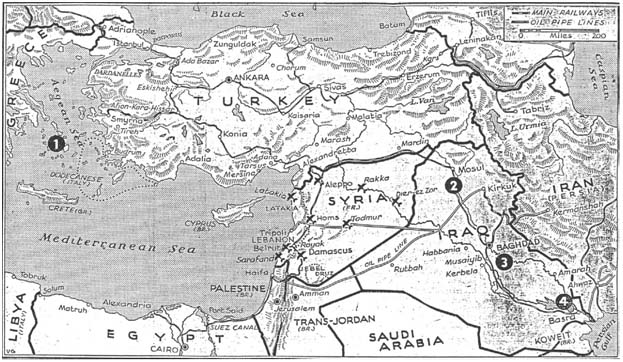
Map 2. Iraq, for a brief period—May 1941—a German foothold in the Middle Eastern door. German planes, presumably flying from the Nazis’ newly acquired island bases in the Aegean Sea (1), were said to be arriving in Syria for action in Iraq. Many of Syria’s military airdromes, the main ones shown on the map by airplane devices, were reported to already be under German control and thus subject to British attack. Nazi planes were declared to have landed around Mosul (2), where there were extensive oil fields, and north of Baghdad (3), the Iraqi capital. British bombers raided the railway near Baghdad, a small arms factory at Musayib in the same area, and barracks at Amarah in the neighborhood of the port of Basra (4). (Source: New York Times, May 16, 1941. Copyright © 1941 by the New York Times. Reprinted with permission.) A more challenging and for the most part undesired development for Berlin in the Middle East began after the Italian dictator asked his German counterpart to support his troops against the British in Libya. Thirty days after Benito Mussolini’s(32) request for help, German troops landed in Libya. A month later, General Rommel arrived, leading the newly founded German Africa Corps into battles leading them close to Alexandria. Since the Germans also occupied Crete, it appeared that the Middle East would be the next major battleground. However, Hitler had already ordered the attack against the USSR for late June 1941. Its outcome spared the Jews in the Middle East from the Holocaust and the region from a terrible experience. Many Middle Easterners, like many Germans, did not recognize the nature of Nazi Germany. Yet some leading thinkers, among them the Egyptian poet Tawfiq al-Hakim, grasped it better. On the other hand, young Egyptian officers, among them Gamal Abdel Nasser and Anwar Sadat, placed their hopes of ridding their country of the British on the Germans.(33) It was not German racism or anti-Semitism that attracted them, but the thorough and fast modernization of Germany under the Nazi dictatorship. Arab nationalists originally admired the fascism of Mussolini, and consequently also of Hitler, as an alternative to Anglo-Saxon democracy and as a modernistic movement. Berlin used this tendency in a selfish and ultimately antihuman manner to create trouble for the Allied powers. Thus, Germany’s Middle East policy resonated from radical Arab nationalists as well. The Middle East again became simply a means for German “out-of-area” aims
toward Europe and America. As Middle Easterners became aware of this nationalistic approach, their disappointment accumulated, as did their potential for anti-Westernism.
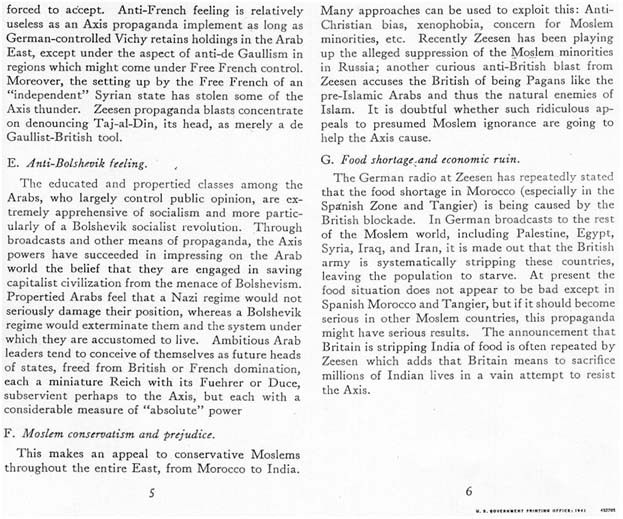
Document 1. An American evaluation of the Axis propaganda in the Muslim world in 1941 BERLIN'S PATTERNS AND PROSPECTS IN THE MIDDLE EAST Otto von Bismarck based Berlin’s secondary Middle East peace policy on three pillars: respecting the status quo, renouncing territorial claims, and mediating conflicts. The most striking paradigm was the subordination of this policy to the always primary policy toward Europe and America. Although the German policy toward the Middle East was direct and active, especially in trade, commerce, and cultural exchange, it contained the same ranking of regional priorities as did the primary policy. First came the Turkish heartland; then the countries under British or French influence, most notably Greater Syria (bilad al-sham, including Palestine and Lebanon); then the other French-influenced territories, especially Algeria and Morocco; and finally the Russian Muslim lands in Central Asia. This order of priorities did not change during either world war. What changed was Berlin’s switch to a primary Middle East war policy directed against Great Britain, France, and Russia. Even then the warfare was asymmetrical, weakening the enemies’ colonial hinterlands from within by incitement to jihad. During World War I, the Ottoman sultan-caliph, the Shaykh of Islam, and a Tunisian mufti promoted the concept, whereas during the World War II, it was the exiled Iraqi prime minister and the Grand Mufti of Jerusalem who advanced this idea. In both cases, the result was a new mixture of critical approaches to Europe’s Middle Eastern empires and of nationalistic aspirations in the declining or former Ottoman Empire. During neither war did Berlin have an explicit design for the Middle East nor any direct goals other than two unsuccessful attempts to conquer the Suez Canal—once with the Ottomans from the East, the other time with the Italians from the West. Yet this direct military involvement resulted from the goals of its coalition partners. Berlin’s original aim in World War I was to fight the European great powers and to maintain the Ottoman Empire’s status quo. Following its collapse, Berlin was willing to respect the national independence of former provinces of the empire. During World War II, Germans favored the idea of a Greater Arabian Empire or a federation associated with the free countries of the region, such as Saudi Arabia and Egypt. Of course they were to be allied with the Axis powers. Clearly, Berlin would not follow Rome’s lead for long. On the contrary, it would end up dictating its junior partner’s policy toward the Middle East. After World War II, some politicians and academics claimed that Berlin had lost its greatest chance for victory after the fall of Paris, and had Hitler chosen the Middle East rather than Soviet Russia as the next big battleground, he might well have succeeded in the fight against London. Although Winston Churchill supported this speculation in his memoirs, Hitler’s nature and the racism that characterized the Nazi system made such a choice unlikely. The dictator was completely oriented toward Eastern Europe and had excluded the idea of German expansion in the Middle East from the beginning. On the other hand, some officers in the Foreign Office worked against Hitler. According to the foremost German envoy to Arab countries, Fritz Grobba, they prevented Hitler from discovering the “Middle Eastern opportunity”—if it at all existed—in the short period of the anti-British revolt in Iraq. It is no wonder that during his final days in his bunker, Hitler talked about the failed agreement with London. If the senseless war against the British could have been avoided even until early 1941, he said, America would not have entered the war. The “false great powers,” France and Italy, he claimed, could have dropped their untimely “policy of greatness.” That would have allowed the Germans a “bold policy of friendship with Islam.” Thus, without the war against the British, Hitler reasoned further, London could have turned to the Empire, whereas Germany could have concentrated on its real mission—the eradication of Bolshevism.(34) This reasoning leads to another conclusion about Berlin’s Middle East policy. In wartime, it became as ideologically oriented as it had been secondary and commercially oriented during peacetime. Its central goal became supporting the war through the export of certain ideologies. During World War I, this meant the export of an Islamic revolution. Germans incited jihad in a subtler fashion during World War II. The Nazis added the deadly racism leading to the Holocaust in Europe and the instigation of anti-Jewish sentiments in the Middle East. This aggravated the Arab-Jewish dispute over Palestine. The project of Jewish assimilation failed in Europe because of the mass extermination of Jews by Germans. Thus, the question of Palestine took on different implications in the region. The Grand Mufti of Jerusalem and the Iraqi premier sent their envoys to visit a concentration camp near Berlin, as a recently discovered report by Dr. Fritz Grobba indicates. On the other hand, there were also Arabs among the prisoners in the Nazi concentration camps. Thus, both leaders and their entourages knew of the existence of such camps and were able to anticipate their use in the coming genocide. After World War II, Middle East policy was not a high priority for the governments of the divided Germany. East Germany essentially went along with the Soviet Union and the Warsaw Pact, while West Germany followed the United States and NATO, subordinating German interests to those of their allies. For example, when Bonn recognized the State of Israel in the mid-1960s, ten Arab states severed diplomatic ties with West Germany, and most of them recognized East Germany by the end of that decade. Germany also had and continues to cope with the burden of the Third Reich; its policies regarding Israel have often been based on moral rather than political criteria. In reunified Germany, the country finally has the opportunity to pursue a genuine primary Middle East peace policy of its own. The new hierarchy in Berlin’s policymaking toward the Middle East seems first to be a focus on truly bilateral or multilateral questions that are framed regionally between Central Europe and the Middle East; second, the influence of bilateral or multilateral security matters on relations with the United States and other third parties; and third, the influence of this bilateral and regional policy toward growing problems of changing multiple identities in Europe and the Middle East. Berlin’s new primary Middle East policy indicates a paradigmatic change from the traditional threefold secondary style (respecting the status quo, renouncing territorial claims, and mediating conflicts) to a primary position. This is an opportunity that also implies risk. Regionally, Berlin’s Middle East peace policy will come under the influence of the cultural patchwork that Europe is becoming. In the past, it was the East-West divide that determined Germany’s alignment. Now, regional and even local factors related to North-South conflicts play a larger role. Moreover, Berlin has taken into account its growing minorities of Jews and Muslims in shaping its Middle East policy, leading to a delicate balance of foreign and domestic policy factors in this new period of globalization.(35) Until recently, the trans-Atlantic relationship was a fundamental pillar of Berlin’s foreign policy, yet it was dealt a blow during the Iraq crisis of 2003, when German politicians opposed the attack by a U.S. and British coalition. Whether Germany will follow NATO or the EU in the future and what role a common European defense and possible European military intervention force will play remain to be seen. Although Berlin seeks to reduce trans-Atlantic disturbances under the leadership of Chancellor Angela Merkel, the Middle East bears a great potential for conflicts among democracies. Beyond the United States and Europe, Islamists look for a policy of playing countries such as Japan, Afghanistan, and India against China, Iran, and Pakistan. *Wolfgang G. Schwanitz holds a Ph.D. in Middle Eastern studies and economics from Leipzig University, Germany. He has authored four and edited ten books on the comparitive history and politics of relations between America, the Middle East, and Europe. He teaches world history at Rider University, New Jersey. Professor Schwanitz is a visting Senior Fellow at the GLORIA Center, Herzliya, Israel. His forthcoming book deals with the German Islam policy, from empire to present.
NOTES (1) Updated and adapted from the author’s introduction in
Wolfgang G. Schwanitz (ed.), Germany and the Middle East,
1871-1945 (Princeton: Markus Wiener Publishers, 2004), p. 1-21.
MERIA Journal
Staff *Serving
Readers Throughout the Middle East and in 100 Countries* |