
Qatar
Qatar contains the third largest natural gas reserves and the largest non-associated gas field in the world. Qatar is also emerging as a major exporter of liquefied natural gas. An OPEC member, Qatar currently exports over 745,000 barrels of oil per day.
Note: The information contained in this report is the best available as of October 2002 and may change.
GENERAL BACKGROUND
Since 1995, Qatar has been ruled by
Sheikh Hamad bin Khalifa al-Thani. Sheikh Hamad has implemented several changes
in policy, including a limited political liberalization creating an elected
council and giving women the right to vote. In the economic sphere, Qatar has
suffered from many of the same problems as other oil-dependent Persian Gulf
states, especially the need to diversify economic development beyond crude oil
exports and scale back the generous state subsidies for consumers, which date
from the oil boom of the 1970s and early 1980s.
Qatar's real gross domestic product (GDP) is projected to grow at an annual rate of 3.8% in 2002, after growth of 3.4% in 2001. This follows a phenomenal growth rate of 11.5% in 2000, which was largely the result of a sharp increase in natural gas exports. Inflation in Qatar remains relatively low, projected at 2.8% for 2002.
Qatar's policy of economic diversification has led to a surge in investment in projects for the export of liquefied natural gas (LNG) and petrochemicals. The government expects that it will be able to earn more per barrel of crude oil produced if it can export refined products and petrochemicals, as well as create private sector jobs - in a country which has been heavily dependent on government ministries to provide employment for the population.
Qatar has begun to pay down its large external debt, which peaked at nearly $12 billion in 1999. Qatar accumulated this debt largely for infrastructure investment in oil and gas projects, which sharply increased Qatar's oil production capacity, construction of facilities for the export of LNG, and petrochemical plants. Qatar's external debt currently is around $7 billion, still equal to more than half of the country's GDP.
Qatar recorded a large budget surplus for the 2001/2002 fiscal year, which ended in March 2002. The Qatari government for the short term has concentrated on reducing its international debts, rather than increasing public expenditures, and has based its budgets on very conservative projections of oil and gas export revenues.
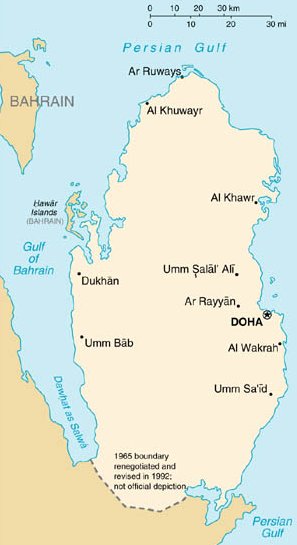
In a ruling issued in March 2001, the International Court of Justice resolved the dispute between Qatar and Bahrain over the Hawar Islands and neighboring islands. Sovereignty over the Hawar Islands was awarded to Bahrain, while Qatar retained the neighboring islands of Zubarah and Janan.
OIL
Qatar has proven,
recoverable oil reserves of 15.2 billion barrels. The onshore Dukhan
field, located along the west coast of the peninsula, is Qatar's largest
producing oilfield. Qatar also has six offshore fields, Bul Hanine, Maydan
Mahzam, Id al-Shargi North Dome, al-Shaheen, al-Rayyan, and al-Khalij. Qatari
crude oil has gravities in the 24o-41o API range. The
country's two primary export streams are Dukhan (41o API) and Marine
(36o API) blend. Despite the country's significant oil production and
reserves, oil accounts for less than 15% of domestic energy consumption. Qatar
exports almost all of its oil production to Asia, with Japan by far its largest
customer. In the first half of 2002, net oil exports totaled 746,777 barrels per
day (bbl/d).
In the first half of 2002, Qatar produced 807,777 bbl/d of liquids (including crude oil, natural gas liquids, and condensate), down from 863,918 bbl/d in 2001. The reversal of the previous upward trend was the result of production cuts undertaken in coordination with OPEC, beginning in Januray 2002. As of June 2002, Qatar's monthly crude oil production was averaging 630,000 bbl/d. The country also produces a significant amount of lease condensate and other natural gas liquids (NGLs), both of which fall outside Qatar's OPEC crude production quota, which has been set at 562,000 bbl/d since January 1, 2002.
Following the coup in 1995, Qatar initiated a number of new policies aimed at increasing oil production, locating additional oil reserves before existing reserves become too expensive to recover, and investing in advanced oil recovery systems to extend the life of existing fields. To accomplish this, the government in recent years has improved the terms of exploration and production contracts and production sharing agreements (PSA). The improved terms are designed to encourage foreign oil companies to improve oil recovery in producing fields and to explore for new oil deposits.
Onshore Development
In March 1998, Qatar signed an onshore oil
exploration agreement with Chevron (now ChevronTexaco), which is still in
effect. It is a five-year PSA and exploration agreement, covering a 4,209
square-mile area known as Block-2. Block-2 covers virtually all of the Qatari
peninsula except for the Dukhan field. Seismic surveys were conducted in 1998,
and drilling commenced in 1999. ChevronTexaco also holds offshore Block-1
jointly with Hungary's MOL.
Offshore Development
One of Qatar's newer oil fields is al-Rayyan,
operated by BP. Wintershall, British Gas, and Gulfstream Petroleum also own
significant shares. The field came on stream in November 1996, producing 20,000
bbl/d of heavy oil from four wells. It lies in offshore Block-11 at the southern
edge of the North Field near Ras Laffan. The PSA for the field was signed on
July 16, 1997. Al-Rayyan has been producing about 25,000 bbl/d in recent months,
and BP Amoco and its consortium partners agreed in April 2001 to further
development of the field which will bring its production capacity up to 60,000
barrels per day by 2004.
Qatar's latest offshore oil field to come onstream is al-Khalij. Production began in March 1997, after five years of exploration and appraisal work, at an initial rate of 6,000 bbl/d. Al-Khalij is located in Block-6, along Qatar's maritime border with Iran, and to the east of the North Field. Development of the field had been delayed since 1991 as Elf Aquitaine Qatar, the field's operator, sought improved production sharing terms from Qatar Petroleum (formerly QGPC). TotalFinaElf (the result of mergers between the three French oil majors, including Elf Aquitaine) completed a capacity expansion in early 2002 which brought the field's total production capapcity to 60,000 bbl/d. Al-Khalij produces a medium/sweet (28o API) oil with about 1% sulphur. The oil is piped to Halul Island for processing and transportation. TotalFinaElf holds a 55% interest in the 25-year PSA, with an option for a five-year extension. The remaining 45% interest is held by Italy's ENI, which acquired the previous owner Agip.
Maydan Mahzam became operational in 1965, and its production is currently under 50,000 bbl/d, which is down significantly from its peak. However, Qatar Petroleum is currently undertaking a renovation intended to extend the life of the field. This work includes plans for 37 new wells over the next decade.
Bul Hanine came on line in 1973, producing well over 100,000 bbl/d, but production began falling off in the early 1990s. Output 70,000 bbl/d by 2001. Development plans to boost production include drilling 86 new wells. Bul Hanine holds approximately 700 million barrels of recoverable reserves.
Al-Shaheen, operated by Maersk Oil Qatar of Denmark, has become one of Qatar's productive oil fields, with production capacity of around 150,000 bbl/d, though production in recent months has been lower due to Qatar's production cutbacks in coordination with OPEC. Located in Block-5 about 43 miles off Qatar's northeastern coast, al-Shaheen produces a sour (29o-33o API) oil with 1.7%-2% sulphur content. The field is thought to be linked to a section of the North Field. Maersk agreed in February 2001 to expand the field to a production capacity of 200,000 bbl/d by late 2004. More than 70 new wells are to be drilled.
Id al-Shargi North Dome (ISND), first discovered by Shell in 1960 and now operated by Occidental Petroleum, lies 59 miles east of Qatar's northern tip. In 1994, the field was producing 12,000 bbl/d when Occidental signed a 25-year PSA with Qatar Petroleum, agreeing to invest $700 million in field development, reservoir repairs, gas and water injection systems, and further exploration. Output from ISND stood at about 100,000 bbl/d in 2001.
In December 1997, Occidental signed another PSA with Qatar Petroleum (then known as QGPC) to develop the Id al-Shargi South Dome (ISSD) oil field. ISSD is located 15 miles from ISND, and Occidental will operate ISSD as a satellite of ISND, keeping overall per-unit operating costs lower. The field came onstream in November 1999 at 11,000 bbl/d, and it was producing around 20,000 bbl/d in 2001. Occidental's ownership interest in ISSD is 44%. ISSD is estimated to contain recoverable reserves of 200 million-300 million barrels.
Downstream
Qatar's QP Refinery (formerly known as the National Oil
Distribution Company) recently upgarded its refinery at Umm Said. The expansion,
completed in early 2002, increased capacity from 57,500 bbl/d to 137,000 bbl/d.
In March 1997, Qatar Petroleum signed a memorandum of understanding (MOU) with the foreign partners of Qatar Liquefied Natural Gas Company (Qatargas) and Ras Laffan Liquefied Natural Gas Company (Rasgas), providing for construction of a condensate refinery at Ras Laffan. While no binding agreement has been concluded, the project is still under active discussion by Qatar Petroleum and TotalFinaElf.
In November 1997, Chevron Phillips Chemical Company signed an $1.1-billion deal with Qatar Petroleum to build a petrochemical plant, Q-Chem, which was completed in 2002. An project to expand the facility, Q-Chem II, is currently under discussion and planned for completion in 2007.
NATURAL GAS
With proven reserves of
509 trillion cubic feet (Tcf), Qatar's natural gas resources ranks third in size
behind Russia's and Iran's. Most of Qatar's natural gas is located in the
offshore North Field, which is the largest known non-associated natural gas
field in the world. In addition, the onshore Dukhan field contains an estimated
5 Tcf of associated and 0.5 Tcf of non-associated gas. Smaller associated gas
reserves also are contained in the Id al-Shargi, Maydan Mahzam, Bul Hanine, and
al-Rayyan offhore oil fields. The Qatari government believes that the country's
economic future lies in developing this vast natural gas potential. Currently,
Qatar has two liquefied natural gas (LNG) exporters: Qatar LNG Company
(Qatargas); and Ras Laffan LNG Company (Rasgas).
The Qatargas downstream consortium comprises QGPC (65%), Total (10%), ExxonMobil (10%), Mitsui (7.5%), and Marubeni (7.5%). In December 1996, the Qatargas venture delivered its first shipment of LNG to Japan. The Qatargas LNG plant consists of three, 2-million-ton-per-year (Mmt/y) (97 billion cubic feet - Bcf) trains. The third train was completed in 1999. Qatargas currently is proceeding with a project to debottleneck its existing liquefaction trains, which is to expand total capacity to 9.2 Mmt/y (446 Bcf) when it is completed in 2005. The eventual construction of a fourth train also is planned.
Rasgas is Qatar's second LNG project. The two major shareholders in the project are QGPC and ExxonMobil. Rasgas consists of two 3.3-Mmt/y (163 Bcf) trains. The first train was completed in early 1999, and loaded its first cargo in August 1999 for South Korea's Kogas, which has a long-term supply contract. The second train came onstream in April 2000. The addition of third and fourth trains is planned. Rasgas contracted with Chiyoda, Mitsui, and Snamprogetti in April 2001 for the construction of the third 4.7-Mmt/y (228 Bcf) train, scheduled for completion in 2004, which will be the single largest capacity LNG train in the world.
Qatar's original markets for its LNG exports were Japan and South Korea, the world's two largest LNG importers. India also may eventually become a major market for Qatari LNG. RasGas signed an agreement in July 1999 to supply 7.5 Mmt/y (365 Bcf/y) of LNG to Petronet, an Indian LNG import and gas distribution project. Deliveries under the Petronet contract are now expected to begin in early 2004. Spain's Enagas also has signed a purchase agreement with Italy's Edison, its first term-contract customer in Europe. Deliveries of 3.5 Mmt/y (170 Bcf) are to commence in 2005.
In May 2000, ExxonMobil and QGPC signed a final development and production sharing agreement for the North Field. The Enhanced Gas Utilization (EGU) project will develop upstream infrastructure in a portion of the field for domestic use, export to neighboring Persian Gulf states, and use as a feedstock for petrochemical projects. The initial phase of the project will produce 500 million cubic feet per day (Mmcfd), with eventual capacity slated to rise to 1.75 Bcf/d.
Another significant proposed project will tie Qatar into the United Arab Emirates (UAE) Dolphin Project, an integrated natural gas pipeline grid for Qatar, UAE, and Oman, with a possible subsea connection linking Oman to Pakistan. The United Offsets Group (UOG), a UAE state-owned corporation backing the project, signed preliminary memorandums of understanding with Qatar, Oman, and Pakistan in June 1999. ExxonMobil also signed a preliminary agreement in June 1999 for the natural gas supply from ExxonMobil's production capacity in the North Field. The total project is expected to cost around $10 billion, including costs associated with the development of more extensive gas distribution networks in the UAE and Oman. Qatar initially will sell around 730 Bcf/y of North Field natural gas, starting in 2005, transported through a subsea pipeline linking the North Field to Abu Dhabi in the UAE. Links between Abu Dhabi, Dubai, and Oman will be added afterwards. UOG announced in March 2000 that TotalFinaElf and Enron had been selected to implement the project, and each would have an equity stake of 24.5%. Enron, however, announced in May 2001 that it was pulling out of the project, and UOG acquired Enron's equity stake, which was resold to Occidental Petroleum in May 2002. The Dolphin Project has been driven in part by the desire of UAE and Oman to use more natural gas for power generation and industrial uses, and the decline in their own production of associated natural gas. Pakistan's participation is highly doubtful, due to its financial condition and the possibility of imports from Iran.
Kuwait also has held discussions with Qatar about the purchase of Qatari gas. A preliminary agreement was signed for gas sales in July 2000, which would source the gas from ExxonMobil's North Field holdings. Details of the project and volumes are still being discussed, and a final agreement has not been reached. Qatar also has held discussions with Bahrain on the possible supply of North Field natural gas, which could be accomplished with a "spur" from the proposed North Field-Kuwait pipeline.
With such vast reserves of natural gas, Qatar has also been interested in potential development of Gas-to-Liquids (GTL) projects. Qatar Petroleum and Sasol signed a preliminary agreement in July 2001 for a 34,000 bbl/d GTL plant at Ras Laffan to be completed by 2005. Foster Wheeler has been engaged to do the initial design work for the plant, but negotiations to secure financing for construction are still underway. ExxonMobil is backing a larger proposed 80,000 bbl/d GTL plant, which could draw on the company's North Field gas production share. A feasibility study is being conducted. Shell and Conoco also have been reported to be studying potential GTL projects in Qatar.
ELECTRICITY
Qatar
currently has an electric generation capacity of 1,475 megawatts (MW), and
produces 9.2 billion kilowatthours of electricity per year. Most of the
country's power plants are natural gas-fired. The residential sector accounts
for about 80% of Qatar's electricity consumption. In response to financial
pressures, the Qatari government announced in 1999 that it would limit the
provision of free electricity to Qatari-citizen households, with payment
required for consumption above a set threshold.
In May 2000, the Qatari government took a major step towards privatization of its power sector. Assets owned by the Ministry of Electricity and Water (MEW) were transferred to the Qatar General Electricity and Water Corporation (QEWC). QEWC is 57% controlled by local investors and 43% controlled by the government.
The Ras Abu Fontas B-plant is the country's largest and newest power and water desalination plant. It currently has an electric generation capacity of 1,030 MW. France's Alstom Power completed an additional 380-MW generation unit at the facility in June 2002.
QEWC awarded a contract in May 2001 for the Ras Laffan Independent Power and Water Project ("Ras Laffan IWPP"), which will be co-located with the Ras Laffan gas and industrial complex. The plant will have a generating capacity of 750 MW when completed in 2004, with the first 430 MW scheduled to be operational by April 2003. AES will own a 55% equity stake in the project, with QEWC holding 45%.
Sources for this report include: APS Review of Oil Market Trends; CIA World Factbook 2001; Dow Jones News Wire service; Economist Intelligence Unit ViewsWire; Gulf News; Hart's Middle East Oil and Gas; International Market Insight Reports; Oil and Gas Journal; Petroleum Economist; Petroleum Intelligence Weekly; U.S. Energy Information Administration; DRI/WEFA Middle East Economic Outlook; World Gas Intelligence.
COUNTRY OVERVIEW
Head of State:
Sheikh Hamad bin Khalifa al-Thani
Independence: September 3, 1971
(from United Kingdom)
Population (2001E):
767,152
Location/Size: Persian Gulf/4,416 square miles, slightly
smaller than Connecticut
Major Cities: Doha (capital), Umm Said,
Dukhan, al-Khawr
Languages: Arabic (English widely spoken)
Ethnic Groups: Arab (40%), Pakistani (18%), Indian (18%), Iranian
(10%), other (14%)
Religion: Muslim (95%)
Defense (8/98):
Army (8,500), Navy (1,800), Air Force (1,500)
ECONOMIC OVERVIEW
Currency: Qatari Riyal
Market Exchange Rate (9/30/02): US$1 = 3.64 Qatari riyals
Nominal Gross Domestic Product (2001E): $16.2 billion (2002E):
$17.0 billion
Real GDP Growth Rate (2001E): 3.4% (2002E): 3.8%
Inflation Rate (consumer prices) (2001E): -0.7% (2002E): 2.8%
Current Account Balance (2001E): $0.5 billion (2002E): $0.0
billion
Major Trading Partners: Japan, United Kingdom, United States,
Italy, Germany, France, South Korea
Merchandise Exports (2001E): $7.7
billion
Merchandise Imports (2001E): $6.4 billion
Major Export
Products: Crude oil, LNG
Major Import Products: Machinery and
transport equipment, manufactured goods, food and live animals
External
Debt (2001E): $7.5 billion (2002E): $7.0 billion
ENERGY OVERVIEW
Minister of Energy and Industry:
Sheikh Abdullah bin Hamad al-Attiyeh
Proven Oil Reserves (1/1/02E):
15.2 billion barrels
Oil Production (1H2002E): 807,878 barrels per
day (bbl/d), of which 611,778 bbl/d was crude oil
OPEC Crude Oil
Production Quota (effective since 1/1/02): 562,000 bbl/d of crude oil (not
including condensate)
Natural Gas Liquids Production (1H2002E):
160,000 bbl/d
Oil Consumption (2002E): 61,000 bbl/d
Net Oil
Exports (1H2002E): 746,777 bbl/d
Crude Oil Refining Capacity
(1/1/02E): 57,500 bbl/d
Natural Gas Reserves (1/1/02E): 509
trillion cubic feet (Tcf)
Natural Gas Production (2000E): 1,027
billion cubic feet (Bcf)
Natural Gas Consumption (2000E): 532 Bcf
Net Natural Gas Exports (2000E): 496 Bcf
Electric Generation
Capacity (1/1/00E): 1.5 gigawatts
Electricity Production (2000E):
9.2 billion kilowatthours
ENVIRONMENTAL OVERVIEW
Total Energy Consumption
(2000E): 0.7 quadrillion Btu* (0.17% of world total energy consumption)
Energy-Related Carbon Emissions (2000E): 9.5 million metric tons of
carbon (0.15% of world total carbon emissions)
Per Capita Energy
Consumption (2000E): 985.2 million Btu (vs. U.S. value of 351.0 million Btu)
Per Capita Carbon Emissions (2000E): 14.1 metric tons of carbon (vs.
U.S. value of 5.6 metric tons of carbon)
Energy Intensity (2000E):
62,814 Btu/$1995 (vs U.S. value of 10,918 Btu/$1995)**
Carbon
Intensity (2000E): 0.9 metric tons of carbon/thousand $1995 (vs U.S. value
of 0.17 metric tons/thousand $1995)**
Sectoral Share of Energy
Consumption (1998E): Industrial (81.8%), Transportation (16.5%), Commercial
(1.5%), Residential (0.2%)
Sectoral Share of Carbon Emissions (1998E):
Industrial (80.4%), Transportation (18.0%), Commercial (1.4%), Residential
(0.2%)
Fuel Share of Energy Consumption (2000E): Natural Gas (84.4%),
Oil (15.6%), Coal (0.0%)
Fuel Share of Carbon Emissions (2000E):
Natural Gas (84.6%), Oil (15.4%), Coal (0.0%)
Renewable Energy
Consumption (1998E): 0.04 trillion Btu* (50% decrease from 1997)
Status in Climate Change Negotiations: Non-Annex I country under the
United Nations Framework Convention on Climate Change (ratified April 18th,
1996). Not a signatory to the Kyoto Protocol.
Major Environmental Issues:
limited natural fresh water resources are increasing dependence on
large-scale desalination facilities.
Major International Environmental
Agreements: A party to Conventions on Biodiversity, Climate Change,
Hazardous Wastes and Ozone Layer Protection. Has signed, but not
ratified, Law of the Sea.
* The total energy consumption statistic includes
petroleum, dry natural gas, coal, net hydro, nuclear, geothermal, solar, wind,
wood and waste electric power. The renewable energy consumption statistic is
based on International Energy Agency (IEA) data and includes hydropower, solar,
wind, tide, geothermal, solid biomass and animal products, biomass gas and
liquids, industrial and municipal wastes. Sectoral shares of energy consumption
and carbon emissions are also based on IEA data.
**GDP based on EIA International Energy Annual 2000
OIL AND GAS INDUSTRIES
Organization: Qatar General
Petroleum Corporation (QGPC) - exploration and production; National Oil
Distribution Company (NODCO) - refining and distribution; Qatar Petrochemical
Company (QAPCO) - petrochemical production; Qatar Fertilizer Company (QAFCO) -
fertilizer production; Qatar Liquefied Gas Company (Qatargas) and Ras Laffan LNG
Company (Rasgas) - production and marketing of liquefied natural gas (LNG)
Major Foreign Oil Company Involvement: BP Amoco Arco, Chevron, Enron,
Exxon, Gulfstream, Maersk, Marubeni, Mitsui, Mobil, MOL, Occidental, Phillips
Petroleum, TotalFinaElf, Wintershall
Major Ports: Umm Said, Ras
Laffan
Producing Oil Fields: Dukhan, Id al-Shargi North Dome, Bul
Hanine, Maydan Mahzam, al-Shaheen, al-Rayyan, and al-Khalij
Major
Pipelines: Dukhan-Umm Said, an offshore network connecting Halul Island to
al-Khalij, Bul Hanine, and Maydan Mahzam, and Das Island (U.A.E.)-al-Bunduq
Major Refineries (capacity - bbl/d): Umm Said (57,500)
Links to other U.S. government sites:
CIA World
Factbook - Qatar
U.S. Department of Energy
- Office of Fossil Energy - Qatar
U.S. State Department Consular
Information Sheet - Qatar
U.S.
State Department Country Commercial Guide - Qatar
U.S. State
Department Background Notes on Qatar
U.S. Embassy in Doha, Qatar
The following links are provided solely as a service to our customers, and therefore should not be construed as advocating or reflecting any position of the Energy Information Administration (EIA) or the United States Government. In addition, EIA does not guarantee the content or accuracy of any information presented in linked sites.
Qatar's Ministry of Foreign Affairs
Qatar Petroleum
U.S.-Qatar Business Council
The Dolphin Project
Planet Arabia.com
Gulf Wire
If you liked this Country Analysis Brief or any of our
many other Country Analysis Briefs, you can be automatically notified via
e-mail of updates. Simply click here, select
"international" and the specific list(s) you would like to join, and follow the
instructions. You will then be notified within an
hour of any updates to our Country Analysis Briefs.
Return to Country Analysis Briefs home page
File last modified: October 2, 2002
Contact:
Lowell Feld
lfeld@eia.doe.gov
Phone: (202)586-9502
Fax: (202)586-9753
URL: http://www.eia.doe.gov/emeu/cabs/qatar.html
If you are having technical problems with this site, please contact the EIA Webmaster at wmaster@eia.doe.gov