           
  

|
| COVER STORY |


|
Catching fire and striking gold From Coke to Citibank, global brands are discovering the value of Arab football. Inside the Mideast money game. By RICHARD DEAN LONDON From canned drinks to credit cards, the lines between football and finance are increasingly blurred in the Arab world. Regional marketing gurus were slow to spot the game’s massive commercial potential – the Middle East is maybe a decade behind Europe and East Asia. But the penny has finally dropped and the Arab world is catching up fast. Soccer sells, and everyone from the smallest local firm to the largest multinational corporation is clamoring to cash in. “Football is an integral part of Gulf-Arab teen passion,” says Dana Mubaidin, public affairs manager for Coca-Cola Gulf. “As most of our marketing efforts are targeted towards this group, we need to not only associate ourselves with football, but to try and own the property.” Media agencies strive constantly to exploit this passion: through advertising, marketing and public relations. “Football certainly guarantees a captive audience in the Gulf, as elsewhere, and that’s a very attractive platform for PR,” says Stephen Worsley, account director with TEAM/Young & Rubicam’s public relations unit. “The global commercialization of football has been so successful that, love it or hate it, there is no escaping soccer. That makes the sport a very powerful communications tool.” Football strikes a particularly resonant chord with the region’s vast youth and young-adult populations. These people have high disposable incomes and are highly brand-conscious, making them a marketer’s dream. “The objective of many PR campaigns is to make a connection with the values people have or aspire to,” explains Dubai-based Worsley. “Football is great for that because it’s a universal language and it’s about youth, passion, a sense of achievement – a whole bunch of exciting things that successful brands want to be associated with.” The World Cup saw a Who’s Who of global brands jumping on the regional football bandwagon. Coca-Cola invested heavily in a string of soccer-based campaigns, while Citibank threw its weight behind a special edition World Cup credit card aimed at its Gulf customers. It is clear, then, that football wields immense power in the Arab media world. But translating that power into profit is not as simple as it might seem – especially in a market where the game is young and global success is so far elusive. “Football as a vehicle is a winner, but the key is doing something creative behind the wheel,” says Worsley. “An under-the-cap promotion to win a football won’t necessarily set everybody’s pulses racing.” On the other hand, overly contrived campaigns risk drowning out the brand’s message. “The idea doesn’t have to be rocket science.” Coca-Cola’s decision to sponsor the Palestinian Football Federation and national team was seen as a bold move. Why? Because arguably the toughest dilemma facing the region’s marketing experts is whether to attach themselves to local or international football teams and celebrities. The Arab world may boast some of the world’s most impressive fans, but the same cannot be said of its players. On an individual, club and national team level, the region’s football cannot compete with the quality – and the glamour – of Europe’s and Latin America’s finest. As such, advertising and marketing campaign chiefs have to decide who and what their young Arab audiences will identify with. Striking the wrong balance risks alienating, not embracing, young consumers. Thankfully, most Arab football fans have split loyalties: a favorite local club and national team, coupled with an international allegiance to the likes of Manchester United and Brazil. “If someone likes the Brazil team, he is a potential customer,” says Elie Wakim, general manager of football marketing company Shoot. “He can easily be lured to local football.” Matters are further complicated by the region’s diverse demographics. “Our core target is local Arab teens of SEC1, 2 and 3,” says Coca-Cola’s Mubaidin. “Thus our efforts to target Western expatriates or Asians – with the exception of the UAE – is minimal.” By their very nature, World Cup-based campaigns had universal appeal, but by and large, different demographic groups have to be targeted with different strategies. “Other campaigns are used when looking at Asian expatriates, who are driven by value. Hence value-added programs are used to target these groups.”
The message is clear: no single strategy can guarantee success. As such, the range of football promotions is only going to get broader. And the scale bigger. Coca-Cola, for example, is already thinking about what it will do for the next World Cup, in 2006. “As the next World Cup gets closer, we will undoubtedly launch new and innovative plans to ‘raise the bar’ on the programs we ran this year,” says Mubaidin. You have been warned. N Building a winner in the Middle East There’s no question that football is on the rise in the region. But can Arab soccer score on the pitch – and make a profit? By GUY BROWN CAIRO Passion. It’s the single most important ingredient for football greatness, and there is no doubt that all Arab nations have a passion for the sport. In this respect, at least, they rival the Brazilians and Italians. However, football clubs in the Gulf, Middle East and North Africa lack the professionalism of their international counterparts, and Arab teams perform poorly in international tournaments.
In the 2002 World Cup, the Arab world was represented by Saudi Arabia and Tunisia; both teams finished last in their respective groups. The performance of a national team draws strength from a country’s football leagues and youth clubs. But the common practice in the region is not to nurture local talent, but to import foreign coaches to produce miracles without attending to the bigger picture. This approach has produced no miracles in the Arab world. A handful of Arab players have also been associated with European football. This includes Saudi Arabian players such as Sami Al-Jaber, who had a spell at English club Wolverhampton Wanderers and who announced his retirement from international football following the World Cup. Nawaf Al-Temyat is another Saudi star, who in the run up to the World Cup was courted by Italian clubs Parma and Brescia, as well as by Dutch side Roda JC. The 2000 Asian player of the year, Al-Temyat’s career was almost ended by injury in March 2001. To some extent, Roda pursued Al-Temyat to boost the club’s profile in the Middle East. The Dutch club’s technical director, Wim Vrosch, said Al-Temyat could bring many assets to his club. “We would also expect to make some money back from any deal, through marketing, TV rights and tournaments in Saudi Arabia,” he said. Arab interest in European football will only grow as hometown boys begin to pop up in matches shown via satellite. For now, however, Al-Temyat remains at Al Hilal club in Saudi Arabia. One of the most successful Arab players in European football is Ahmed (“Mido”) Hossam who is signed with Holland’s Ajax. Just 19, Mido is potentially a future goldmine for the club. Despite some genuine talents and the lure of tapping into Arab viewing audiences, offers have never exactly flooded in for Arab players. “Even when Egypt won the African championship in 2000, the offers only came from Turkey, Austria, and Belgium, not from the top leagues in Europe,” says Abdel Rahim. This year is particularly bad because the bottom has fallen out of the European transfer market. Clubs have put investment on ice and pursued reductions in player salaries. Transfers. There are also cases of Arab clubs bungling transfer opportunities, mishandling the process of negotiating transfer fees and contracting. “They have paid for their mistakes. They were not preparing professional contracts,” says Abdel Rahim. So, for example, Mido left Zamalek for his first foreign club, Belgium’s K.A.A. Gent, without the club getting any compensation, and another player went from the Arab Contractors team to Portugal, he says. “Arab Contractors complained to FIFA, but they only got a small sum compared to if they had handled it properly in the first place.” Ismail Osman, chairman of Ismaili club, Egyptian league champions last season, says he is looking to contact sports marketing agencies to make sure transfer opportunities are pursued and executed correctly by his club. The agencies can handle the transfer of players to foreign clubs, and make sure the process of negotiating transfer fees and detailing contracts is carried out professionally. The players themselves can also be a problem. “Transferring to a foreign club is seen as career enhancing, but Egyptian players lack the essential discipline required to play top flight football,” says Mustafa Abdel-Wadood, the co-founder and managing director of Sigma Capital and an avid football enthusiast. “You have your average player, he does well, gets exposed to media and money, and then without the discipline there is not much of a career left.” Abdel Rahim also faults Egyptian players on their discipline, saying Egyptian players with talent believe they are too good to need to practice. Sometimes, Arab money is invested in European football instead of at home. Mohamed Al Fayed – owner of London’s Harrods department store and chairman of Fulham Football Club, which is in England’s Premier League – is investing heavily in Fulham to achieve his vision of making it the Manchester United of southern England. There are hopes of a £70 million redevelopment of the club’s old ground. More widely known is Libyan leader Muammar Gadhafi’s investment in Juventus. In January, Juventus confirmed that the Libyan Arab Foreign Investment Company (Lafico) had bought a 5.3 percent in the Turin-based club – worth around $22 million. Gadhafi wants to build a 20 percent stake in Juventus as part of a plan to develop Libya’s soccer talent, according to his son Al-Saadi. Al-Saadi, 28, is mad about the game. He is Libya’s footballer of the year, captains the national team, is head of the Libyan soccer federation and is president of Tripoli’s Al Ittihad football team. Friendlies. “This cannot be considered a financial deal. Libya believes in sport and in its youth, and Juventus will help us to develop the enormous potential of our football,” said Al-Saadi. “We really want to qualify for the 2006 World Cup.” Libya came last in their 2002 qualifying group. The investment gives Gadhafi some leverage, and Juventus has apparently agreed to play friendly matches in Libya. Gadhafi’s interest in football and oil dollars to burn represent a light of salvation for some. In August, fans of cash-strapped Greek football team PAOK sent a letter to the Libyan leader pleading for his help in saving the club from financial ruin. PAOK’s largest supporters’ club sent the letter to the Libyan embassy in Athens, calling on Colonel Gadhafi to oust the team’s unpopular owner, George Batatoudis. At home, across the region, national team performance is an area of concern. Lebanon has taken some drastic measures in the past in the pursuit of instant fixes for the national team. Six months prior to the Asian Cup finals in 2000, five players with Lebanese roots from Brazil’s second and third divisions were imported to enhance the national team’s chances of putting up a good show. Lebanon finished last in its group, highlighted by a 4-0 defeat by Iran in the opening game before a capacity crowd. “It is difficult to judge which Arab nation is ahead. Moroccan football has declined – from 1995 to 2000, Morocco was the strongest African team,” says Mohamed Abdel Rahim, the host of Nile TV’s Sports Mania. The show is a weekly program that covers sporting events on the Arab and African scene, and throughout the world. “Currently Tunisia is the best of the worst, but all the Arab teams are in decline. Egypt is always seesawing, and Saudi Arabia has gone down.” In football, the distinctions separating the Arab peoples are at their sharpest. For frustrated societies, football is a focus for dreams and an outlet for pent-up emotions. The competitive spirit in matches is fiercer between Arab nations than between Arab and non-Arab nations. “Egypt against other North African nations – Algeria, Morocco and Tunisia – are major grudge matches,” says Abdel Rahim. He goes on to list Egypt and Saudi Arabia, and Saudi Arabia and Kuwait as other key games. Kuwait and Iraq would also be a big grudge match but following the Gulf War the two countries have not met on the pitch, he says. Even when there is no obvious animosity, football can produce awkward situations. Egypt is a recipient of Saudi Arabian largesse: investment and tourism through the summer, plus millions of jobs for Egyptian expatriates. At one point, Egypt dominated the Saudi Arabian national team – Abdel Rahim says Egypt notched up 13 successive victories until disaster struck in 1991, when Saudi Arabia defeated Egypt 5-1. “For Saudi Arabia and Kuwait, beating Egypt is more important than beating one of the world greats like Brazil,” he says.” At club level, there are no clear winners, either. Fresh from defeating AS Roma in a friendly match held in Cairo in August, Al Ahly promptly lost to Raja Club of Morocco, and is struggling to qualify for the next round – it is the defending champion. However, archrival Zamalek is doing better, leading its group. Publicity. Arab league clubs have many problems in common. The game in Lebanon, for example, is financially deprived due to recession, plus the growing popularity of basketball, which some say is now the country’s top sport. However, Lebanon’s real ailments are a familiar cry throughout the region. For instance, the main football authority – the Lebanese Football Association (LFA) – has recognized the need for major action, but is mired in its own problems. Elections for chairmanship of the LFA took place in September 2001, amid criticisms that the wrong people are getting into governance positions for the wrong reasons. These positions are often pursued by those interested in generating publicity for private business interests. Hassan Sabra, who unsuccessfully bid for the presidency of the Lebanese FA, said, “This debacle at the local football scene should find its ultimate end, with only correct and highly committed people taking charge of the hot seats at the football association.” A key challenge facing Arab football is falling attendance. “Clubs are suffering from low attendance not because the tickets are costly but because the matches are broadcast on TV,” says Abdel Rahim. “Even the pitch perimeter advertising targets television viewers.” TV has sucked many spectators away from the grandstands, but there has not been a countercurrent of TV revenues into club pockets, as has been the case in European football, and pay-per-view is yet to take off. Also, the gate fees to watch a game are a pittance. “Ninety percent of the fans pay one Egyptian pound to watch a football game, which may rise to three or five pounds for important matches,” says Abdel Rahim. There is also a barrier to developing TV revenues. “Egyptians regard it as almost a right to watch Egyptian football,” says Abdel-Wadood. Some clubs have it better than others: Al Ahly and Zamalek in Egypt have pride of place on the state TV channels and are better financed than other clubs. Libya and Egypt have both sought to bring well-known foreign clubs out to play local teams. In August, AS Roma played in Cairo against Al Ahly. On the pitch it was a serious affair for Al Ahly, who came out 2-1 winners. The objective of the so-called friendly matches is, most of all, to make money. “These are money games. When Al Ahly played Real Madrid it reportedly invested 7-8 million Egyptian pounds in the game, but it got 11 million Egyptian pounds back in advertisements and TV broadcasting,” says Abdel Rahim. The games promote tourism, too. The idea to hold the Al Ahly-AS Roma came up in a meeting last November between Egyptian Minister of Tourism Mamdouh El Beltagui and the Italian ambassador. “The idea is to bring the attention of the population to the destination [Egypt] that they are used to going there and give them the real image of the country as a friendly country and a secure environment,” said El Beltagui. With sightseeing tours arranged for the players, the event generated significant exposure for Egypt with several TV networks from Italy, China and Japan picking up the event. The picture that emerges from Arab football is that there is plenty of awareness about what is wrong, and plenty of ideas to improve the game. There is also, quite clearly, plenty of money to be made. N
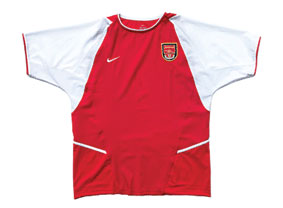
Fans call Ahmed (“Mido”) Hossam the Cairo King. As a key player with Dutch team Ajax, Mido is certainly playing top-flight professional football. Mido has averaged a goal every 113 minutes, which makes him the second-most prolific player in Holland. Just 19 years old, he has a potential superstar future. Mido also embodies what is possible for Arab footballers if they have a chance to thrive in a professional football environment, one where football is about both passion and business. Mido has some of England captain David Beckham’s star appeal, which could be transferred into lucrative sponsorship deals with the right image management. As an indication of the potential, Mido featured in Vodafone advertisements in the Middle East during the World Cup. Mido’s career started out briefly with Egyptian team Zamalek; he made his senior team debut at the age of 17. After just four matches he moved to Belgian side AA Gent in a free trial. Mido finished his first season there with 11 goals in 23 appearances. He made his national team debut for Egypt prior to his 18th birthday. Mido left Gent and joined Ajax of Amsterdam in a $4 million transfer; he is on a five-year contract for $5 million, more than enough to pay for the professional footballer’s sports car. Where Mido goes now in football is a matter of wise career moves, discipline and an injury-free career. There is additional risk – there is a conflict between Mido’s European lifestyle and that advocated in his homeland – far more so than, for example, a Spanish player playing in the English premiership, and Mido has already shown a rebellious streak a mile wide. In September, Mido announced that he wanted to leave Ajax, having just been dropped from the starting lineup for one match. This show of pique did not endear him to anyone associated with the club. But he later retracted his comments, apologizing to fans and management, and earning himself a fine. Mido has not been shy to speak out – and upset his fellow players for doing so while at Gent. However, Mido also hitched up with Joke van der Velde, Miss Belgium 2000, while at the Belgium club, which may have roused some feelings of jealousy among fellow players. He has since broken up with Miss Belgium, and married a fellow Egyptian last summer. Rebelliousness helped get Mido where he is today. By his own admission as a youth Mido skipped school to play more football, with his father enticing him to play to win with 3 Egyptian pounds ($0.65) in reward money. That helped to complete the sting. “I bribed the postman (a friend of mine), who was supposed to bring letters from the school to my parents’ house. Therefore, my parents never found out that I was never at school,” Mido said in an interview posted on his own website. Mido is a player with the requisite knack for goal scoring and the stature –189.5 centimeters – to last in professional football. He has described his style as similar to that of Dutch international Patrick Kluivert. He also likes Argentine international Gabriele Batistuta’s game. Mido may in time join the football legends. He says Arsenal, Juventus and AS Roma have shown interest in him, and Liverpool is also reported to have made inquiries. Luciano Moggi, the general director of Juventus, is said to have offered $18 million for him. Mido has opted to stay put with Ajax, stating his interest to allow his talents and skills to ripen. Sensible given Ajax’s global reputation for nurturing young players, and that the bottom has fallen out of the European transfers market. To be great Mido will need to tame his arrogance enough to take onboard important lessons from past and present masters of the game. The finer grade of football player is a result of hard work and steady development. Mido has shown an appetite for hard work, but it looks as though he will need a leash to keep on track. He is in familiar company at Ajax with fellow Arab Hatem Trebelsi, a Tunisian. Mido is not yet renowned as a world-class player, but he is certainly in the upper echelons of European club football and can look forward to a decade of further development. So far he has taken a pragmatic approach to his career. He misses his homeland but speedily left Zamalek in pursuit of a career-enhancing opportunity. He announced his desire to leave Ajax – which he later withdrew – but he reportedly maintains an interest in moving to other clubs in the coming years when the time is right and he has furthered his development at Ajax. If the rebel yell is channeled, Mido could become, after Zinedine Zidane of France, the next global Arab sports megastar..
|
 The business of arab football
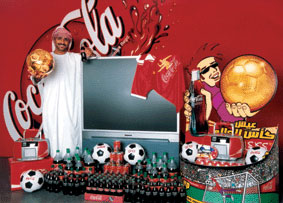 With so many complicating – and often competing –
forces at play, what is the golden key that will unlock the region’s
footballing treasure chest? “Campaigns have to make the most of
their resources,” says Worsley. “A Gulf roadshow with Ronaldo [the
Brazilian star of World Cup 2002] would be a sensation, but it’s
unlikely to happen. Perhaps for this reason there tends to be more
of a focus on the fans and the grassroots level – local tournaments,
coaching sessions with former players and so on.” Coca-Cola is
investing heavily in a “Street Football” campaign that targets young
Arab football fans in this way.
With so many complicating – and often competing –
forces at play, what is the golden key that will unlock the region’s
footballing treasure chest? “Campaigns have to make the most of
their resources,” says Worsley. “A Gulf roadshow with Ronaldo [the
Brazilian star of World Cup 2002] would be a sensation, but it’s
unlikely to happen. Perhaps for this reason there tends to be more
of a focus on the fans and the grassroots level – local tournaments,
coaching sessions with former players and so on.” Coca-Cola is
investing heavily in a “Street Football” campaign that targets young
Arab football fans in this way.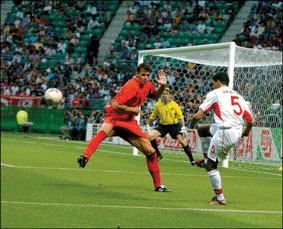 A lack of success on the playing
field has translated into poor performance for the business of Arab
football. Advertisers, after all, want to be associated with
winners. And fat contracts are for now the reserve of the (mostly
European and South American) elite.
A lack of success on the playing
field has translated into poor performance for the business of Arab
football. Advertisers, after all, want to be associated with
winners. And fat contracts are for now the reserve of the (mostly
European and South American) elite.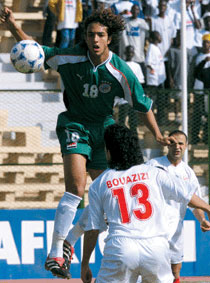 The making of mido