Digital Economy, E-money and Developing Countries
2. Electronic payment systems
Any money is adopted for its three principal functions: measurement, payment, saving.
E-commerce is based on electronic payment systems. Those systems deal with virtual money (cyber money). E-commerce transactions comprise three actors: consumer, seller and banks. When dealing in e-commerce, we care about privacy and authentication. To fulfill those criteria, e-commerce procedures are based on public key encryption and the digital signature technique.
Here we present the principal ideas to understand the mechanism adopted for transactions in e-commerce.
Figure 3: Privacy (H)

Figure 4: Authentication
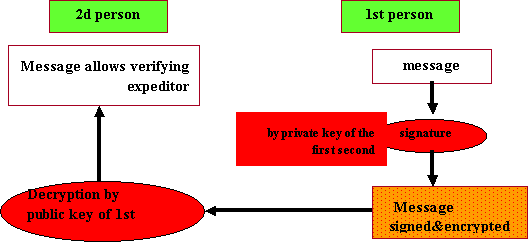
Main idea is that if a message is encrypted by a private key it could be decrypted by the appropriate public key (which can be published without any problem). But, the only way to decrypt encryption by public key, is to obtain the private key (his owner is the only one who has it).
Every actor in e-commerce has his private and public key. when sending messages from one person to another, he will prove the authenticity of the message when signing it by using his private key [Privk1()]. For privacy and security, he will encrypt the message once again by using the public key of the person where the message is addressed [Pubk2(Privk1())]. Therefore, the message will be encrypted twice. After receiving it, the message will be decrypted twice also by using the opposite operations [Privk1(Pubk2())].
Steps, mentioned above, explain clearly the general mechanism to ensure exchanges on e-commerce. But the reality is more complex because communications are achieved after encrypting several times, and by exchanging firstly the public keys of each other. Those keys could be available or valid and could be modified in every transaction or period. Looking for simplicity we limited our presentation to elementary concepts.
We believe that e-money is merely an array of bytes. Therefore, it will be very easy to copy. In other words there is the risk of money creation (phenomenon of double spending). In order to respond to these needs, enterprises try to propose solutions. Some experts propose a combination of software with hardware (cards). Others, insist solutions using protocols and software only.
We distinguish two main categories of electronic payment systems :Online systems and Offline systems.
-
Online systems require, for every transaction, a simultaneous verification of data. These systems remind of the mechanism of present banking cards. Consequently, hardware is indispensable to fulfill its operations.
-
Offline systems: Hardware is used in some kinds of these systems, like the smart card. This card has a chip with small database, sufficient to verify double spending. Preferring not to use hardware, electronic payment systems (with continuous more perfect software) seem to have a promising future. We recognize also in these offline systems (based only on software) two kinds of money: anonymous e-money and identified e-money. Identified e-money trace the path of the money (i.e. who owns it? and where did he get it from?). Here we have big risk of violation of privacy, but problems of double spending will be limited. If privacy is a dominant criterion, systems can use anonymous e-money.
According to the US Congress's General Accounting Office GAO:
US Banks Need to Step Up Security Measures. (I) On August 5th 1999, a GAO study showed that 44% of financial institutions surveyed were found to have taken insufficient steps to limit the risk factor associated with online banking. In its report, the GAO concluded that Internet banking is riskier than offline banking.
In particular, the report pointed to the failure of a number of boards of directors in approving strategic plans for Net banking and to draw up policy and procedure documents. However, the GAO found no instances of security breaches or financial losses in its survey.
The challenge facing the government and the American banking system today is to ensure that the rush to technology does not outpace financial institutions proven ability to provide full security and privacy, according to Spencer Bachus, the Chairman of the House Banking subcommittee.
The findings are based on a study of 81 financial institutions across America, of which 35 were found to have been lax in implementing the necessary security measures. The report did acknowledge that the findings were not conclusive, given the small sample of banks surveyed and the focus on banks readiness for Y2K.
In June, Goldman Sachs reported that 4% of US households currently use online banking products and services, predicting that this would increase to 20% of households by 2002.
Once money moves online, it moves out of the control of central banks, crippling their ability to run the economy. Banking authorities will no longer be able to conquer inflation by putting up interest rates because holders of virtual money will not be affected by changes in the cost of borrowing in the real economy. The deputy governor of the Bank of England is quoted as saying that once central bankers lose their monopoly over printing money "the successors to Bill Gates would have put the successors to Alan Greenspan out of business ". (J)
Expansion of e-money is reinforced with loyalty procedures adopted by most of e-commerce companies. Some firms adopted loyalty schemes (like Beenz, ipoints and Flooz) which pay customers, visiting their internet sites, in credits susceptible to be spent online. Others are based on accumulating reward points.
Despite the fact that e-money is not yet a real money, and depends on number of sites which will accept it, it seems to have a good future. C.COHEN (founder of Beenz.com) confirm that e-money can't be downloaded or spent in the non-electronic economy.
But he foresees a world in which private electronic money becomes more popular than official money issued by central banks. "It will be less than a decade before private companies start issuing their own currencies," says Cohen. The consequences will be profound. He accuse classical means of payment (cash and checks) to be cumbersome and expensive.
The real revolution will occur, when companies no longer need to use the banking system to settle their bills with each other. Now financial settlements between firms are achieved through the banking system. Central bank control monetary system by deciding money supply and interest rates. Consequently Central bank have leverage over the whole financial system.
If bills settlement between companies is possible electronically, directly and without banking system, then central banks will lose their control over the economy. Electronic payment systems will allow companies to instantly transfer wealth, without the risk of default. Once there is no need to use the conventional banking system, there is no need to use national currencies either.
Companies can create their own currencies backed by their wealth. Some articles invite us to imagine a world where Microsoft has its own currency (called Bills perhaps). Companies trading with Microsoft could decide whether to invoice in Bills or dollars. Individuals might prefer to be paid in Bills if they thought that Microsoft money might be less inflation-prone than the pound or the dollar. Using existing smart card technology, Bills could be downloaded into electronic wallets, which would allow them to be used in the real economy instead of cash or checks.
Being an international network, one may aspires the invention of an international e-money susceptible to protect consumers from national currencies fluctuation among different countries.
Presently, customers can use most of electronic payment systems to pay securely using existing national currencies. Few of these systems (Beenz and Flooz) use more truly e-currencies, but are too limited in circulation to compete with money.
A company like American Express could be imagined to launch its own e-money (may be called Amex). It already has a money substitute: travelers checks. It may disserve peoples in countries suffering from inflation and hyperinflation.
For the libertarian right, private money is a long-held dream which the internet may finally provides the technology to fulfill it. "Money does not have to be created legal tender by governments. Like law, language and morals, it can emerge spontaneously. Such private money has often been preferred to government money, but government has usually soon suppressed it," wrote Frederich Hayek, 50 years ago.
Legal tender - government control over printing money - is a fairly recent development in most countries. In the US, private banks issued money until the creation of the Federal Reserve in 1913. The Bank of England has held a monopoly over printing notes and coins since 1921, but the government did not control the money supply until Thread needle Street was nationalized by the post-war Labor government.
For libertarians, the monopoly of central banks has been a disaster. It simply allows governments to cheat their citizens by eroding the value of their savings through bouts of inflation. If there were different types of money in circulation, consumers could choose which they thought was least likely to loose its value over time.
We remind that our article do not treat quarrels between libertarians and Keynesians or neoclassics. We wanted to show new economic horizons imagined for the new era of "e-life" or "virtual life". This invite us to enumerates principal fears or preoccupations for the future of DC.
| (H) |
More details on privacy: Achieving Electronic Privacy, David Chaum, Scientific American, August 1992, Scientific American, Inc. Back to text |
| (I) |
More details on www.gao.gov Back to text |
| (J) |
More details on: Guardian Unlimited November 4, 1999. Back to text |