1. Introduction
The digital revolution, when compared with other technical revolutions, is the quickest (B). Steam engine dominated the period from 1712 to 1831 when electricity discovered by Faraday. The electricity should wait one hundred years to be generalized. Launched in 1946, digital revolution began with the invention of the first computer (10 feet tall and 150 feet wide, cost millions of dollars and could execute up to 5000 operations per second). 25 years later, Intel made a chip (12 mm2 cost 200$ and 12 times more powerful). Today, Chips can execute hundreds million operations per second and much cheaper.
Computerization associated with the network and communication revolution (C), will expand speedily in the digital economy.
We prefer dealing with the internet and the e-commerce phenomenon within the reality of the globalization and its impacts on Developing Countries (DC). This phenomenon is not recent, and can be understood as the internationalization begun by the discovery of new lands and Colonization. For the postcolonial periods, we can highlight the principal globalization steps through the following stages:
- Internationalization by Trade: This stage is characterized by the dominant flow of finished goods from industrialized countries to DC, confined to exporting raw materials.
- Internationalization by Direct Foreign investment: After adopting protectionist policies by DC, developed countries tried to blow up the frontiers by investing directly inside DC. This new strategy leads to a big market extension, gives an opportunity to exploit the cheap labor force, and insures a new period of stable growth (specially after the communication revolution).
- Internationalization by Financial globalization and Capital mobility: Now there is a real financial investment eviction which threatens productive and physical one. The disproportion between the volume of capital movement across the world and the international trade volume confirms it.
Internet and electronic commerce claim to be a good way to remove frontiers and to make the world a small village. This assertion needs to have some details on the internet advantages. Here we try to mention its principal characteristics:
- Shopping 24 hours a day.
- Save time and expenses of moving between shops in traditional trade.
- Possibility to purchase in all markets (national and international).
- More information, more choice, less waste in papers, and in writing materials.
- Easier looking for items and quicker correspondence by E-mail.
- Increasing competitiveness and augmenting effective demand.
- New styles in collecting information and in advertising…. Knowing these advantages, what opportunities for DC to get benefit of?
1. Could DC improve their commercialization using e-commerce? Is it possible inside or abroad?
2. How can e-money influence monetary policy?
Those two questions will be treated through a particular case study on Syria.
Comparing internet users in the middle east with those in the world, we find a large disparity.
Figure 1.a: Users in some neighbor countries
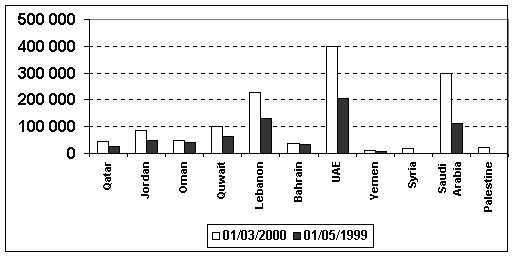
Figure 1.b: Total of users in the world (millions)
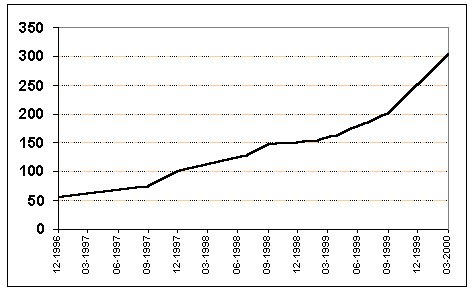
Source: Nua Internet How many online, http://www.nua.ie/surveys/how_many_online/index.html
Despite the remarkable growth in internet users in some Arab countries, we suppose that it should be very difficult to commercialize inside national frontiers. Here we enumerate principal factors which make commercializing difficult inside:
- Small national market size and weak purchasing power: The majority
of DC depends on agriculture and some artisans and ateliers. Low wages,
and inflation make it difficult to buy hard-ware necessary to navigate
or to buy. In developed countries, a single monthly salary is sufficient
to buy all materials needed for internet (computer, modem and the subscription);
while a normal employee in DC need, at least, 4 times his salary to do
the same. On the other hand, the propensity to consume basic goods (food,
transport, clothes..) is higher in those countries. Consequently, even
when salaries increase in early stages of economic growth, it will be very
difficult to see sufficient users of internet inside.
Statistics scarcity and absence of its credibility: When using e-commerce, it is primordial to have exact statistics (D), as soon as possible, to carry out market studies and analysis in order to well plan investments and projects.
Difficulties in computerizing enterprises: even when computerizing enterprises, it seems to be an apparent change; Abroad, computerizing means more productivity and less labor and minus bureaucracy. However, in DC, computerizing leads to more jobs, more bureaucracy and complication. In other words, here we see the computerization of underdevelopment!
Underdevelopment of banking systems: Using payment systems through internet needs high performance from banking system, and good experience in financial activities. Most of arab countries show a very under developed banking system (E).
Insufficient infrastructure: using internet needs in addition to computers and modems, a communication infrastructure (F). But even if this condition was satisfied, it is necessary to know that e-commerce can deliver only some kind of goods and services via terminals. All others need to be conveyed physically. Competition imposes quick delivery, which is not possible without a planned transport infrastructure. Scarcity of new transport means (vehicles, roads, rails, etc.) shows the challenge in front of those countries. Furthermore, electric cuts practiced in several regions will exercise pressure on internet expansion. Finally, we refer to the bad organization in Post services, which can influence all commerce varieties.
Old laws and improvised fiscal or monetary policy: It is urgent to get rid of inertia by updating and modernizing the law system to match new economic circumstances. This will be very urgent specially when we know that circumstances in internet field change continuously. Furthermore, it will be very dangerous with the absence of an international regulation in this domain.
Arab language and the internet: when using e-commerce to expand sales inside, DC will face the difficulty of ignorance of foreign language (english) for the major part of arab consumers. Therefore, the solution could be in proposing two interface: arabic and english. But arabic interface software is still virgin and needs more efficiency. In fact, the real problem resides in the analphabetism of an important part of arab population.
Finally, do we need such a big speed to carry out our purchasing? What benefit of contracting in few minutes through internet, when export and import or delivering goods need weeks or even months?!
Let us take the syrian case. Its commercial balance shows a durable deficit (Most of exports are raw materials).
Figure 2: Syrian exports & imports
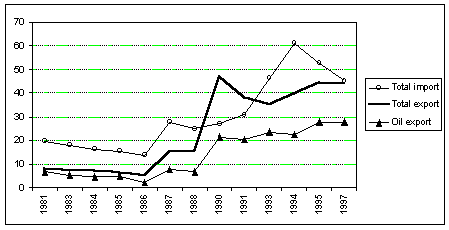
Source: Statistical abstract, Central bureau of statistics, Damascus.
In addition to contracting (and clearing debts and executing financial operation), internet allows delivering directly certain goods and services (book, soft-wares, music,…). But it is obvious that it would be impossible to deliver a larger number of booked items.
Governments must pay attention to avoid concentration of new investment in brokerage and trading foreign goods; They must sustain national investment in electronic trade of national products. They have to lead a long run strategy to ensure the exploiting of e-commerce in developing healthy and competitive productive enterprises.
With the internet revolution, a gap is created between the ancient business style (old economy), and the new economy based on telecommunication. In financial market, most analysts and observers confirm that the stock value of the traditional industrial enterprises (old economy) are decreasing; while the stocks of the internet firms (e-business) are increasing.
Some experts said that, old economy will suffer when introducing e-business in its firms. This introduction will increase productivity, but it will decrease prices simultaneously because it will blow up most intermediaries (G).
Furthermore, Governments must also ensure trusted and efficient payment systems. This idea drives us to the second part of our paper.
New economy drastic changes are not limited to the productive structure (old economy), they affect directly banking systems creating serious risks.
| (B) |
Digital economy or e-economy means basically that firms and different economic units are using digital data and make information exchanges through internet. Back to text |
| (C) |
"Today, a strand of optical fiber as thin as a human hair can transmit in a single second the equivalent of over 90 000 volumes of an encyclopedia". Lucent Technologies . Back to text |
| (D) |
When using e-commerce, investors need at least to know the internet users natures: male-female, young-old people, living in cities or villages….. Back to text |
| (E) |
For more details on banks roles in financing and planing economic activity, see D.DERGHAM, "about the role of banking structure in economic plan", First SIMA conference in Damascus, may 1999. Back to text |
| (F) |
Now, telephones in some departments in Damascus still respond engaged because of its overloading by normal phone calls. What will be the situation when several users will navigate during hours a day. Now there are important investments to improve and modernize ancient machines and phone nets.. Back to text |
| (G) |
More details on different explanations: review Le point, p.96, 14 April 2000. Back to text |